Looking for a state’s official UCC search? Pick the state on the map at UCC search by state: each state’s own free online search, its certified search request and the fee, one click away.
What a UCC search answers
A UCC search asks the filing office one question: which financing statements are on file against this debtor's name. Article 9 makes the office answer it. On request, the office must report “whether there is on file on a date and time specified by the filing office, but not a date earlier than three business days before the filing office receives the request, any financing statement that” names the debtor and “has not lapsed under section 336.9-515 with respect to all secured parties of record”, together with “the date and time of filing of each financing statement” and “the information provided in each financing statement” (UCC 9-523(c), as enacted (Minnesota's text)). Lapsed filings are reported only “if the request so states”.
Three kinds of people run that search. A lender, lessor, factor or supplier searches before it advances money, to see who already claims the same collateral. A title, closing or legal team searches to prove the record is clean on a given day. And a business owner searches its own name after a lender, a credit report or a letter mentions a UCC lien, to see what is filed and by whom. The method is the same for all three: the right state, the debtor's exact name, the office's own search, and a careful read of every record it returns.
UCC 9-301, 9-307 and 9-523(c) and (d), as enacted (Delaware's and Minnesota's texts); IACA Model Administrative Rules 503 and 505. The amber step is the one searchers skip: the state's index is not the only place a lien is recorded.
Where to search
Search where the financing statement had to be filed, and that depends on where the debtor is located, not where the business operates or the collateral sits. The rule is that “while a debtor is located in a jurisdiction, the local law of that jurisdiction governs perfection, the effect of perfection or nonperfection, and the priority of a security interest in collateral” (UCC 9-301(1), as enacted (Delaware's text)). For a corporation, LLC or limited partnership the answer is short: “A registered organization that is organized under the law of a State is located in that State.” (UCC 9-307(e), Delaware's text). For a person: “A debtor who is an individual is located at the individual's principal residence.” (UCC 9-307(b)(1)).
So a Delaware LLC with its offices in Texas is searched in Delaware, and a sole proprietor living in Ohio is searched in Ohio, wherever the shop is. The IRS gives the same example from the other side, to warn its own staff: “a UCC security interest on the inventory of a corporation with a principal executive office in California, which was incorporated in Delaware, would be filed in Delaware” (IRM 5.17.2). The where to file a UCC-1 guide covers organizations that are not registered, foreign debtors and federally chartered entities. Each state's own search, fees and quirks are on its page under UCC filing and search by state.
The exact name and the search logic
Filing office searches do not guess. IACA's model rules put it plainly: “Human judgment does not play a role in determining the results of the search.” (IACA MARS 503). The office applies a fixed set of rules, its standard search logic, to the name you enter. For organizations the model rules ignore case, punctuation and spaces and a listed set of ending words such as Inc. or LLC (Maine is one state that keeps those endings: 29-250 CMR ch. 401); for individuals “The individual debtor surname on a filed record must exactly match the surname of the search request.” (MARS 503.1.4(a)).
That logic is also the legal test of a filer's mistake. A filing with the wrong debtor name is seriously misleading, but “If a search of the records of the filing office under the debtor's correct name, using the filing office's standard search logic, if any, would disclose a financing statement that fails sufficiently to provide the name of the debtor in accordance with section 336.9-503(a), the name provided does not make the financing statement seriously misleading.” (UCC 9-506(c), Minnesota's text). A search under the correct name is therefore the search the law relies on. Start there; the UCC lien search guide explains when to add variations, and the debtor name rules explain what the correct name is.
Free searches and certified searches
Most states put a name search online, and many charge nothing for it. IACA's own search request form starts by pointing people there: “Online searches are often faster and less costly than those conducted using this form.” (Form UCC11, instructions). The online search is usually an informational one. When you need the office's own report, ask for a certified search. The statute gives you that right: “if requested, the filing office shall communicate information by issuing a record that can be admitted into evidence in the courts of this State without extrinsic evidence of its authenticity” (UCC 9-523(d), Delaware's text).
Counted from each state's fee schedule, statute and search pages, as of November 2026. A free search is rarely a certified one: certified searches carry their own fee in almost every state.
The national request form is Form UCC11. Check the “CERTIFIED (Optional)” box for an official report; the form warns that “certified searches may have a longer turnaround time and additional fees may apply”, and “If no box is checked, the filing office will perform a NON-CERTIFIED search by default.” Many states take the request online instead. Certified search fees vary widely: Colorado and North Dakota charge nothing, while Connecticut charges $50 per debtor name. The state table in the lien search guide lists each office's search and certified search with its fee, and certified UCC searches covers the request itself.
What the state index leaves out
A clean search of the central index is not a clean bill of health. Fixture filings, timber and mineral filings go to the county real property records (UCC 9-501(a)(1)); vehicles and other titled goods are perfected on the certificate of title; deposit accounts are perfected by control, not filing; and notices of federal tax lien against individuals usually sit in the county of residence. Some states fold tax liens into the UCC search and some do not: by their own pages, 29 jurisdictions include tax liens in the central UCC search, 13 do not (Alaska, Georgia, Kentucky, Maryland, Massachusetts, Minnesota, Missouri, New Mexico, North Carolina, Ohio, Rhode Island, Vermont, West Virginia), and the other 9 do not say. Two guides take these gaps one at a time: what a UCC search does not show and federal tax lien search.
Guides in this section
- UCC lien search: choosing the state and the name, running the free search, reading each record, certified searches, and every state's official search with its fee.
- What a UCC search does not show: county fixture filings, tax liens filed elsewhere, titled goods, interests perfected without filing, the through date and lapsed records.
- Federal tax lien search: where each state has the IRS file its notices, why that is often not where the UCC-1 is, and a table of offices for every state and DC.
- Certified UCC search: the UCC11 request and each state's certified search.
- UCC filing fees by state: search and certified search fees beside the filing fees.
If the search turned up a filing against your own business, the UCC liens for borrowers section explains what it means and how to get it terminated.
Templates
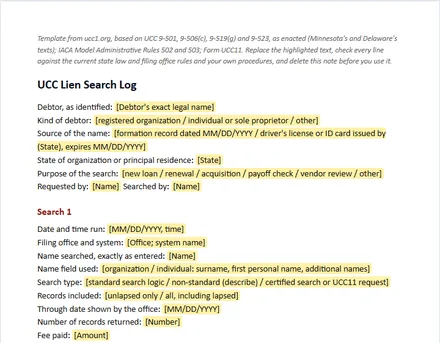
Lien search log
Record each UCC search: the name as entered, the office, the search type, the through date, every filing's file number and lapse date, and the follow-up. Word download.
Common questions
What is a UCC search?
A search of a filing office's index for financing statements filed against a debtor's name. Under UCC 9-523(c) the office reports each unlapsed financing statement naming the debtor, with its filing date and time and the information in it, as of a date no earlier than three business days before it gets the request.
Which state do I search?
The state where the debtor is located: for a corporation, LLC or limited partnership, the state where it was organized (UCC 9-307(e)); for an individual, the state of the person's principal residence (UCC 9-307(b)(1)). That is often not where the business operates.
Is a UCC search free?
In many states the online name search is free, sometimes with an account. 5 jurisdictions (Delaware, Kansas, Louisiana, New Jersey, South Dakota) say they have no free public search, and certified searches carry a fee almost everywhere.
What is the difference between a free search and a certified search?
The free online search is usually informational. A certified search is the filing office's own report, issued on request under UCC 9-523(d) as a record that courts admit without other proof. Lenders and closing teams order one when the result has to be relied on.
Does a UCC search show tax liens?
Only in some states. By their own pages, 29 jurisdictions include tax liens in the central UCC search and 13 do not; the rest do not say. Notices of federal tax lien against individuals are usually filed in the county. See the federal tax lien search guide.
Sources
- UCC Article 9 as enacted: Minnesota Statutes 336.9-506 and 336.9-523; Delaware Code title 6, Article 9, subchapter III (9-301, 9-307) and subchapter V (9-501, 9-523)
- International Association of Commercial Administrators: Model Administrative Rules (2024), rule 503; Form UCC11, Information Request (Rev. 07/01/23)
- IRM 5.17.2 (federal tax liens and UCC filings)
- Each state's search page and fee schedule, as cited on its state page