- Who completes it
- Usually the secured party of record; a debtor only for a termination the lender failed to file
- Filed with
- The office that holds the UCC-1, with the fee
- Form revision
- Rev. 07/01/23 (IACA)
- Pages
- Instructions on page 1, the form on page 2
- Always required
- Item 1a (file number) and item 9 (authorizing party)
At a glance
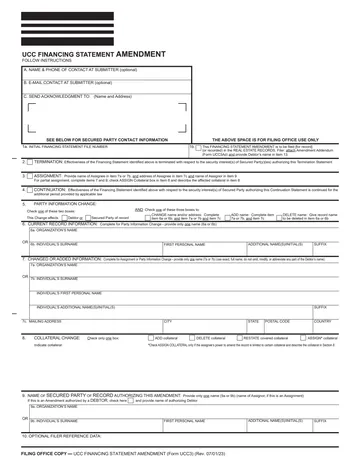
Form UCC3 is the UCC Financing Statement Amendment in IACA's national set. The current version prints “(Rev. 07/01/23)” at its foot; page one is the instructions and page two the form. Download it from IACA's UCC Forms and Resources page (the 2023 UCC3 PDF).
- Who completes it. Usually the secured party of record, or its filer. A secured party stays on the record until an amendment removes it: a person “remains a secured party of record until the filing of an amendment of the financing statement which deletes the person” (Del. Code tit. 6, 9-511(c)). A debtor completes it only for the narrow termination case in item 9.
- What it can do. Terminate (box 2), assign (box 3), continue (box 4), change the parties (items 5 to 7) or change the collateral (item 8). It cannot extend a filing any other way: apart from a continuation, “the filing of an amendment does not extend the period of effectiveness of the financing statement” (Del. Code tit. 6, 9-512(b)).
- Where it goes. To the same filing office as the UCC-1, with the fee, by paper where the office still takes it or through the office's online system. 11 jurisdictions take amendments online only, or on paper only with an exception (see each state page).
- What the office does with it. Indexes it against the original. Nothing is erased: “The filing office shall not delete any information from the information management system in response to an amendment.” (MARS 307). A terminated or lapsed filing stays searchable for a time; the office “may not remove a debtor's name from the index until one year after the effectiveness of a financing statement naming the debtor lapses” (Del. Code tit. 6, 9-519(g)).
Tap a box once for its note, again to jump to the line. Zoom in to read the small print.
Boxes A to C and item 1
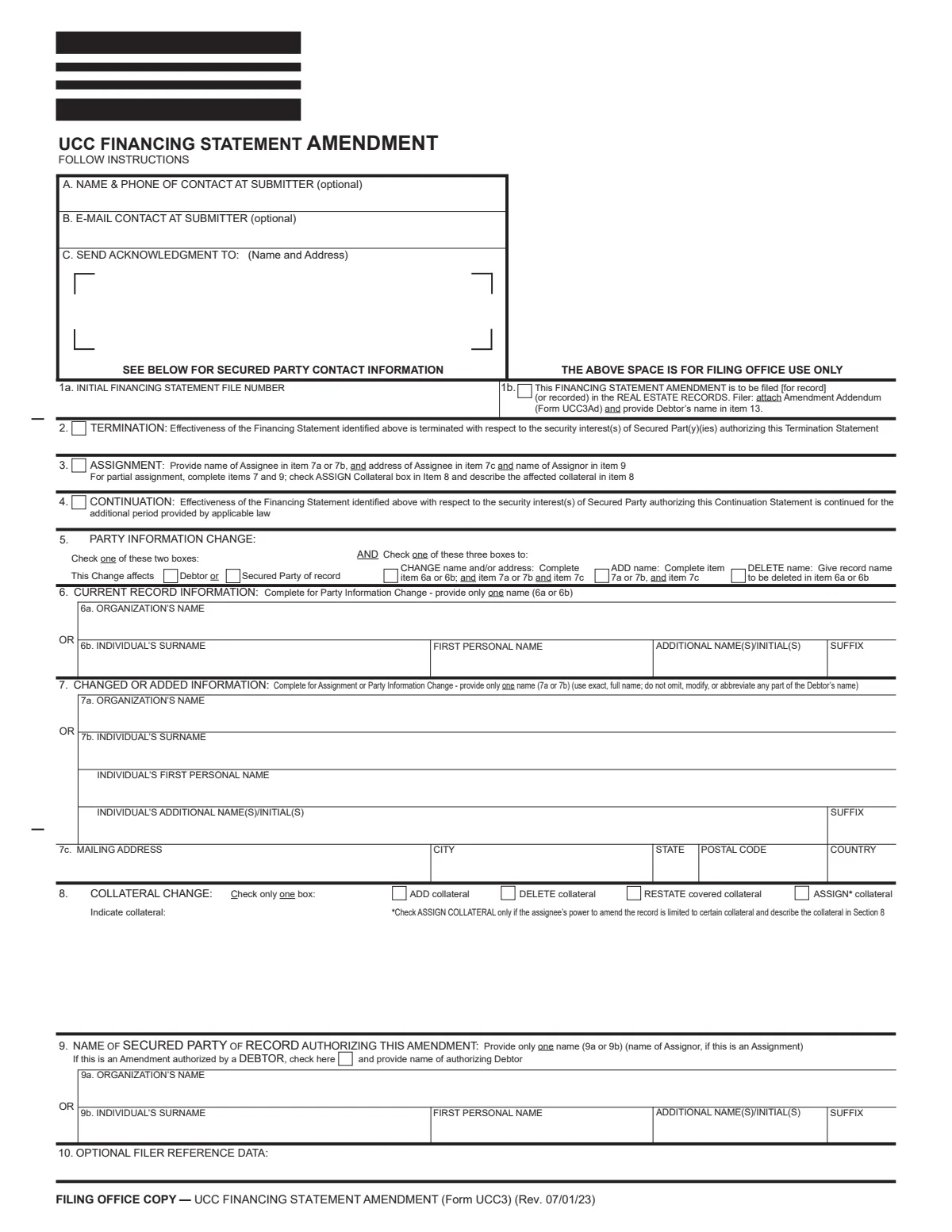
The submitter boxes work as on the UCC-1. Item 1a is the one item no amendment can skip: without the original file number the office cannot tell which filing the amendment changes, and in the uniform text a record that does not identify an initial financing statement is treated as a new one (Del. Code tit. 6, 9-516(c)(2)).
| Line | Label | What goes there |
|---|---|---|
| A | NAME & PHONE OF CONTACT AT SUBMITTER (optional) | As on the UCC-1: an optional contact for the filing office, not a party. |
| B | E-MAIL CONTACT AT SUBMITTER (optional) | Optional e-mail contact for the filing office. |
| C | SEND ACKNOWLEDGMENT TO: (Name and Address) | Where the acknowledgment goes. The amendment gets its own file number and filing date and time; keep it with the original UCC-1's acknowledgment as the record that the amendment was filed. |
| 1a | 1a. INITIAL FINANCING STATEMENT FILE NUMBER | The anchor of every amendment. The statute requires an amendment that “identifies, by its file number, the initial financing statement to which the amendment relates” (Del. Code tit. 6, 9-512(a)(1)). The instructions: one file number only. Some local offices also want the original filing date, which may be added after the file number. An office refuses an amendment that does not identify the initial filing, or that “identifies an initial financing statement whose effectiveness has lapsed under Section 9-515” (Del. Code tit. 6, 9-516(b)(3)(B)): a lapsed filing cannot be amended or revived. |
| 1b | 1b. This FINANCING STATEMENT AMENDMENT is to be filed [for record] (or recorded) in the REAL ESTATE RECORDS | Only for filings in the county real property records (fixture filings, timber to be cut, as-extracted collateral). Check it, attach the Amendment Addendum (Form UCC3Ad) and give the debtor's name in its item 13; if the debtor has no interest of record, the record owner goes in item 16. Central (Secretary of State) amendments leave 1b blank. |
Boxes 2 to 4: terminate, assign, continue
The page one note sets the pattern: “Show purpose of this Amendment by checking box 2, 3, 4, 5, or 8”, then complete the items that box names. Boxes 2 and 4 need nothing else but items 1a and 9.
Form UCC3 and instructions (Rev. 07/01/23); Del. Code tit. 6, 9-509(d)(2), 9-512, 9-513, 9-514 and 9-515(d).
| Line | Label | What goes there |
|---|---|---|
| 2 | 2. TERMINATION | Check box 2 to end the filing. The printed text: the financing statement “is terminated with respect to the security interest(s) of Secured Part(y)(ies) authorizing this Termination Statement”. Its effect in the statute: “upon the filing of a termination statement with the filing office, the financing statement to which the termination statement relates ceases to be effective” (Del. Code tit. 6, 9-513(d)). A secured party whose loan is paid must file or send one “within 20 days after a secured party receives a signed demand from a debtor” (Del. Code tit. 6, 9-513(c)); see UCC termination. New York's Department of State describes the same steps: “If you are using the National Standard form, UCC3 Financing Statement Amendment you would complete 1a Initial Financing Statement file number and check box 2 for Termination.” |
| 3 | 3. ASSIGNMENT | For a transfer of the loan or lease. A secured party of record “may assign of record all or part of its power to authorize an amendment” (Del. Code tit. 6, 9-514(b)). Check box 3, put the assignee's name in 7a or 7b and always give the assignee's mailing address in item 7c; the assignor's name goes in item 9. For a partial assignment, also check ASSIGN collateral in item 8 and describe the collateral. Offices add the assignee to the record: “An amendment that designates an assignee shall cause the assignee to be added as a secured party of record” (MARS 307). |
| 4 | 4. CONTINUATION | Keeps the filing alive past its lapse date. The instructions: “a continuation statement must be filed within six months before the lapse date”. The first and last permitted days come from the filing office's rules. The statute: “A continuation statement may be filed only within six months before the expiration of the five-year period” (Del. Code tit. 6, 9-515(d)), and “A continuation statement that is not filed within the six-month period prescribed by Section 9-515(d) is ineffective.” (Del. Code tit. 6, 9-510(c)). A timely continuation “continues for a period of five years commencing on the day on which the financing statement would have become ineffective in the absence of the filing” (Del. Code tit. 6, 9-515(e)). Filing two in the same window gains nothing: “The lapse date is extended once, notwithstanding the fact that more than one continuation statement is filed within a given 6-month period prior to a lapse date.” (MARS 308.1). |
Form UCC3 instruction 4; Del. Code tit. 6, 9-515(a), (d) and (e); MARS 201 and 308.1. Wyoming runs ten years and a few filings run 30; see the continuation page.
The lapse date and window for any filing date and state are in the lapse date calculator; the rules, including the states with longer periods, are on the UCC continuation page.
Items 5 to 7: party changes
Item 5 is two rows of check boxes. The 2023 form asks for one choice in each row: whose information changes (a debtor or a secured party of record) and what happens to it (change, add or delete). Item 6 identifies the name now on the record; item 7 gives the new or added name and address. An amendment cannot leave a filing with no one on it: an amendment is ineffective if it “purports to delete all secured parties of record and fails to provide the name of a new secured party of record” (Del. Code tit. 6, 9-512(e)).
| Line | Label | What goes there |
|---|---|---|
| 5 | 5. PARTY INFORMATION CHANGE: This Change affects Debtor or Secured Party of record; CHANGE name and/or address, ADD name, DELETE name | Two choices, both required for a party change: whether the change affects a debtor or a secured party of record, and which of three actions. To change a name or address, give the current record name in item 6 and the new name in item 7a or 7b, with the address in 7c. To add a party, use item 7 only. To delete a party, use item 6 only. The 2023 revision removed the old leading check box from item 5 (IACA revision guide). |
| 6a | 6. CURRENT RECORD INFORMATION; 6a. ORGANIZATION'S NAME | The name exactly as the record shows it now, so the office can link the change to the right party. Only one name, 6a or 6b. |
| 6b | 6b. INDIVIDUAL'S SURNAME / FIRST PERSONAL NAME / ADDITIONAL NAME(S)/INITIAL(S) / SUFFIX | The current record name of an individual party. |
| 7a | 7. CHANGED OR ADDED INFORMATION; 7a. ORGANIZATION'S NAME | The new name, the added party or the assignee, formatted like item 1 of the UCC-1: the exact, full name, nothing left out or abbreviated. An added debtor is covered only from the amendment: a financing statement amended to add a debtor is effective as to that debtor only from the date of the filing of the amendment (Del. Code tit. 6, 9-512(d)). A debtor whose name changed so far that the old name is seriously misleading needs this amendment within four months to cover collateral acquired after that point (Del. Code tit. 6, 9-507(c)); see debtor name rules. |
| 7b | 7b. INDIVIDUAL'S SURNAME; INDIVIDUAL'S FIRST PERSONAL NAME; INDIVIDUAL'S ADDITIONAL NAME(S)/INITIAL(S); SUFFIX | An individual's new or added name, one part per line. The same state name rule (Alternative A or B) applies as on the UCC-1. |
| 7c | 7c. MAILING ADDRESS / CITY / STATE / POSTAL CODE / COUNTRY | Always completed when item 7 is used. An office refuses an assignment that “does not provide a name and mailing address for the assignee” (Del. Code tit. 6, 9-516(b)(6)), and an amendment adding a debtor or secured party without its address. |
Item 8: collateral change
Item 8 changes what the filing covers. Deleting collateral is how a secured party releases part of what it financed, for example equipment the debtor sold with the lender's consent.
| Line | Label | What goes there |
|---|---|---|
| 8 | 8. COLLATERAL CHANGE: ADD collateral, DELETE collateral, RESTATE covered collateral, ASSIGN* collateral | Check one box and describe the collateral under it (more space on the UCC3Ad, item 14). “A partial release is a DELETE collateral change.” Added collateral counts only from the amendment: a financing statement amended to add collateral “is effective as to the added collateral only from the date of the filing of the amendment” (Del. Code tit. 6, 9-512(c)). The asterisk box is not a collateral change: “Check ASSIGN COLLATERAL only if the assignee's power to amend the record is limited to certain collateral”, together with box 3. The 2023 revision added that wording and removed the leading check box (IACA revision guide). |
Items 9 and 10: who authorizes it
A UCC-3 is not signed. Item 9 names the party whose authority makes it effective, and the office does not check that authority: it files what it receives. A termination filed without authority is not effective, but it can still look effective on a search, so lenders review their filings.
| Line | Label | What goes there |
|---|---|---|
| 9 | 9. NAME OF SECURED PARTY OF RECORD AUTHORIZING THIS AMENDMENT; If this is an Amendment authorized by a DEBTOR, check here | “Always complete items 1a and 9.” “In most cases, the authorizing party is the Secured Party of record.” In an assignment it is the assignor. Only an entitled person's amendment works: “A filed record is effective only to the extent that it was filed by a person that may file it under Section 9-509.” (Del. Code tit. 6, 9-510(a)). The check box is the debtor's own route, and only for a termination: “If this is an Amendment (Termination) authorized by a Debtor, check the box in item 9 and enter the name of the Debtor authorizing this Amendment in item 9a or 9b.” The statute allows it only where the secured party failed to file or send a required termination and “the termination statement indicates that the debtor authorized it to be filed” (Del. Code tit. 6, 9-509(d)(2)); see how to remove a UCC lien. |
| 9a | 9a. ORGANIZATION'S NAME | The authorizing party's organization name, as it appears on the record (or the debtor's, for a debtor-authorized termination). |
| 9b | 9b. INDIVIDUAL'S SURNAME / FIRST PERSONAL NAME / ADDITIONAL NAME(S)/INITIAL(S) / SUFFIX | The authorizing party's name if an individual. More authorizing parties go in item 18 of the UCC3Ad or on an exhibit. |
| 10 | 10. OPTIONAL FILER REFERENCE DATA | For the filer's convenience only. The instructions on page one bar financial account numbers anywhere on the form. |
One action or several, and the fees
The form has boxes for five purposes, but it does not promise that an office will take more than one on a single form. “Some filing offices may accept certain combinations of multiple actions on an Amendment. Filing offices that accept multiple actions may charge an additional fee.” The state rows show the offices whose fee schedules speak to it, by action or by form:
| State | UCC-3 online | UCC-3 on paper |
|---|---|---|
| Alaska | $10 per function (amendment, assignment, continuation, partial release, termination) | $10 per function (amendment, assignment, continuation, partial release, termination) |
| Arkansas | $6 plus $0.50 per uploaded page; termination free for filings after July 28, 1995 ($6 for older filings) | $6 per action (one action per UCC-3); termination free for filings after July 28, 1995 ($6 for older filings) |
| California | $5 per purpose (termination, continuation, assignment or amendment) | $10 (1 to 2 pages), $20 (3 or more pages) per purpose, termination included |
| Georgia | $25 each for amendment, assignment, continuation or termination | $25 each for amendment, assignment, continuation or termination |
| Nebraska | $11 (one fee for several changes on one amendment); termination free | $14; termination free |
| Tennessee | $15 each for a collateral or secured party change, assignment, continuation or termination; $15 per debtor for debtor changes; $0.50 each page over 10; card or e-check convenience fee | $15 each for a collateral or secured party change, assignment, continuation or termination; $15 per debtor for debtor changes; $0.50 each page over 10 |
| Washington | $23 | $30 (first 2 pages; several amendment actions on one form for one fee), $1 each added page |
| Wyoming | $7.50 amendment (several actions for one fee); $15 continuation; termination free | $15 amendment (up to 2 pages), $30 (more than 2 pages); $30 continuation; termination free |
A termination costs nothing extra in these states, because the rows list it as free or included in the UCC-1 fee:
| State | UCC-3 online | UCC-3 on paper |
|---|---|---|
| Alabama | $15 plus $9.75 access fee and $5.50 efficiency fee; termination free | $20 (1 to 2 pages), $2 each added page; termination free |
| Arkansas | $6 plus $0.50 per uploaded page; termination free for filings after July 28, 1995 ($6 for older filings) | $6 per action (one action per UCC-3); termination free for filings after July 28, 1995 ($6 for older filings) |
| California | $5 per purpose (termination, continuation, assignment or amendment) | $10 (1 to 2 pages), $20 (3 or more pages) per purpose, termination included |
| Florida | $12 first page, $3 each added page; termination included in the UCC-1 fee | $12 first page, $3 each added page; termination included in the UCC-1 fee |
| Louisiana | Not listed | $25 (amendment, continuation, assignment); termination prepaid at the original filing |
| Maine | $10; termination free only for financing statements filed July 1, 1993 to June 30, 2001 | $15 (1 to 2 pages), $30 (more than 2 pages); same termination rule |
| Michigan | $15, terminations included | Not accepted |
| Missouri | $10 by statute, terminations included (15 CSR 30-90.040: $17) | $17 plus $1 per page for attachments; termination $17 per filing |
| Montana | $5 (continuation, assignment, partial release, other amendments); termination free | Not accepted |
| Nebraska | $11 (one fee for several changes on one amendment); termination free | $14; termination free |
| North Dakota | $40 amendment or assignment; $30 continuation; termination free; information statement $40 | Not accepted |
| South Dakota | $20; termination free | $25 (1 page), $5 each added page; termination free |
| Utah | $12 per page; termination free | $12 per page; termination free |
| Wisconsin | $10; termination free | $20; termination free |
| Wyoming | $7.50 amendment (several actions for one fee); $15 continuation; termination free | $15 amendment (up to 2 pages), $30 (more than 2 pages); $30 continuation; termination free |
Illinois is the case where a page and the statute differ: its forms page shows terminations free, while 810 ILCS 5/9-525 lists $20 for any record, and the statute governs (see the Illinois page). Every state's UCC-3 fee is in the UCC filing fees by state table and the fee finder.
What a filed termination changes is limited. The financing statement stops being effective, but in IACA's model rules “The filing of a termination statement shall have no effect upon the status of any party to the financing statement or upon the status of the financing statement.” (MARS 309). The record and its index entry stay until the office's retention rules let it go.
Mistakes the form invites
- The wrong file number in 1a. Use the initial financing statement's number, not an earlier amendment's.
- A continuation outside the window. Too early or too late, it is ineffective, and a late one is a refusal ground (Del. Code tit. 6, 9-516(b)(7)). One timely continuation in the window is enough.
- Treating ASSIGN collateral as a collateral change. It belongs with box 3, for a partial assignment.
- Expecting a deletion to vanish. A deleted debtor or secured party stays visible on the record; MARS 307 says offices delete nothing.
- A debtor-authorized termination too soon. The debtor box in item 9 is lawful only after the secured party failed to file or send a termination it owed. Start with the signed demand (the termination demand letter).
- Two actions where the office takes one. Check the office's rules first; a refused form is not filed at all.
How it connects
The rules behind each box are on the guides: UCC-3 amendments, UCC termination, continuation and, for the business on the other side, how to remove a UCC lien and wrongful UCC filings. A debtor that thinks a record is wrong but cannot amend it uses the UCC5 information statement, which does not change the filing. The original filing is the UCC1 form; all national forms are on the forms hub.
Common questions
Can I terminate and assign on the same UCC-3?
Only where the filing office accepts several actions on one form. The instructions say some offices do and may charge more; others take one action per form. Check the state page or the office's rules before combining them.
Can a debtor file a UCC-3 termination?
Only in one case: the secured party had to file or send a termination statement and did not. The debtor then checks the box in item 9 and gives its own name. Start with a signed demand; the secured party has 20 days to act.
When can I file a continuation?
Only within the six months before the lapse date. A continuation filed earlier or later is ineffective, and a filing that has lapsed cannot be continued; a new UCC-1 is needed.
Does a termination remove the filing from UCC searches?
Not at once. The financing statement stops being effective, but the office keeps the record and may not drop the debtor's name from the index until one year after the filing lapses.
What file number goes in item 1a?
The file number of the initial financing statement (the original UCC-1), from its acknowledgment. Enter only one file number per form.
Is a partial release a termination?
No. Releasing some collateral is a DELETE collateral change in item 8, with the released collateral described. Box 2 ends the whole filing as to the authorizing secured party.
Sources
- IACA, UCC Financing Statement Amendment (Form UCC3) (Rev. 07/01/23), with its instructions
- IACA, UCC Forms Revision Guide (2023)
- IACA, Model Administrative Rules (2024 ed.): rules 201, 307, 308 and 309
- IACA, UCC Forms and Resources
- Delaware Code, title 6, Article 9, Part 5 (9-509 to 9-516 and 9-519), the uniform wording as Delaware enacted it
- New York Department of State, UCC frequently asked questions