- Who completes it
- The secured party or its filer, with the UCC1
- Filed with
- The same office as the UCC1, as one record
- Form revision
- Rev. 07/01/23 (IACA)
- Room per copy
- 3 debtors and 2 secured parties or assignors
- Items
- 18 to 24
At a glance
Form UCC1AP is the UCC Financing Statement Additional Party form in IACA's national set. It prints “(Rev. 07/01/23)” at its foot, with the instructions on page one and the form on page two. Download it from IACA's UCC Forms and Resources page (the 2023 UCC1AP PDF).
Its only job is names. The instructions: “Use this form (multiple copies if needed) to continue adding additional Debtor or Secured Party names as needed when filing a UCC Financing Statement (Form UCC1).” Each copy holds three more debtors (items 19 to 21) and two more secured parties or assignors (items 22 and 23). Item 24 is space for a state's own requirements.
- Who completes it. The secured party or its filer, with the UCC1. No signature.
- When it is needed. When the UCC1 (two debtors, one secured party) and the addendum (one more of each) are not enough. A UCC1AP may be attached with or without a UCC1Ad. California's office says the addendum and additional party forms “only should be completed and submitted with Form UCC1 or Form UCC3 if needed to record additional debtors and/or secured parties”.
- Where it goes. With the UCC1, to the same office, as one record. Every name on it is indexed against the same file number.
- The legal basis. “A financing statement may provide the name of more than one debtor and the name of more than one secured party.” (Del. Code tit. 6, 9-503(e)). There is no limit in the uniform text; the limit is the fee some offices charge per name.
- Statutory form or office form. California's office lists the forms its statute sets out (the UCC1, UCC1Ad, UCC3 and UCC3Ad); the additional party forms are not among them. Offices take the UCC1AP as an IACA form they approve under their own rules; IACA's model rule adds: “A list of forms approved by the filing office will be made available on request.” (MARS 102).
Tap a box once for its note, again to jump to the line. Zoom in to read the small print.
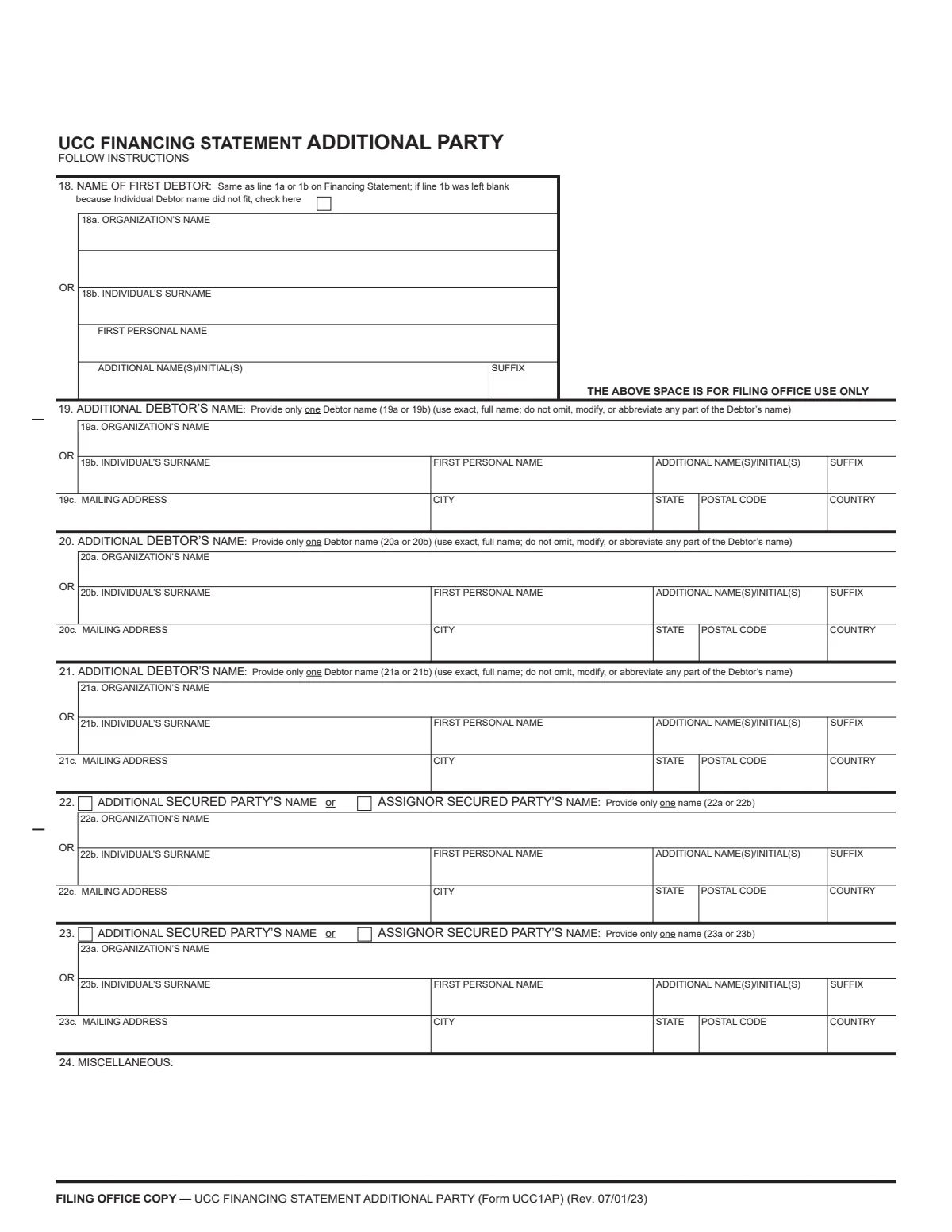
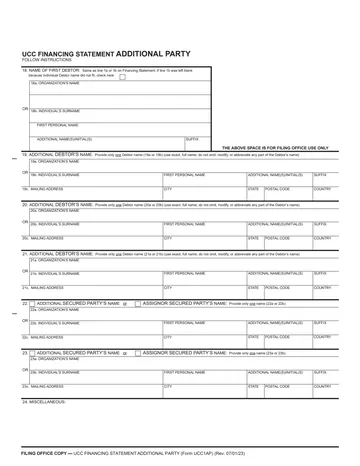
Forms UCC1, UCC1Ad and UCC1AP (Rev. 07/01/2023); the UCC1AP may be attached in as many copies as needed.
Item 18: the cross-reference
Item 18 repeats the first debtor from the UCC1 so each additional party page stays tied to its financing statement. The space to its right is for filing office use only.
| Line | Label | What goes there |
|---|---|---|
| 18 | 18. NAME OF FIRST DEBTOR: Same as line 1a or 1b on Financing Statement; if line 1b was left blank because Individual Debtor name did not fit, check here | The page's link to its UCC1, as on the addendum's item 9. “The name will not be indexed as a separate Debtor.” (instruction 18). If you attach several copies of the UCC1AP, repeat the same first debtor on every copy. |
| 18a | 18a. ORGANIZATION'S NAME | The organization name from line 1a of the UCC1, copied exactly. |
| 18b | 18b. INDIVIDUAL'S SURNAME / FIRST PERSONAL NAME / ADDITIONAL NAME(S)/INITIAL(S) / SUFFIX | The individual name from line 1b. Where line 1b was left blank because the name was too long, the instructions say to “check the box in item 18 and enter as much of the Individual Debtor name from item 10 that will fit” (instruction 18). |
Items 19 to 21: more debtors
Each of items 19, 20 and 21 is a full debtor entry: one name, as an organization or an individual, with its own mailing address. The form's own header for each debtor item sets the rule: use the exact, full name, and do not omit, modify or abbreviate any part of it. That matters more here than anywhere, because an added debtor is often a subsidiary or affiliate whose name differs from the borrower's by one word.
| Line | Label | What goes there |
|---|---|---|
| 19 | 19. ADDITIONAL DEBTOR'S NAME: Provide only one Debtor name (19a or 19b) (use exact, full name; do not omit, modify, or abbreviate any part of the Debtor's name) | Items 19 to 21 are filled in under instruction 1 of the UCC1, the same rules as the first debtor. The header repeats the one-name rule: “Provide only one Debtor name (19a or 19b)”. Each debtor name is a separate entry: “Each debtor name provided by the initial financing statement shall be indexed in the UCC information management system” (MARS 306.2). |
| 19a | 19a. ORGANIZATION'S NAME | An entity's name exactly as its public organic record shows it, with the corporate ending. A subsidiary or affiliate that also grants a security interest is its own debtor, under its own exact name. To confirm a registered name and the entity's status, see how to check a company's good standing on goodstandingrules.com. |
| 19b | 19b. INDIVIDUAL'S SURNAME / FIRST PERSONAL NAME / ADDITIONAL NAME(S)/INITIAL(S) / SUFFIX | A natural person, including a guarantor who pledges personal assets or a sole proprietor. The state's Alternative A or B rule decides which name; see UCC debtor name rules. |
| 19c | 19c. MAILING ADDRESS / CITY / STATE / POSTAL CODE / COUNTRY | Required for every debtor. An office refuses a record that names a debtor and does not “provide a mailing address for the debtor” (Del. Code tit. 6, 9-516(b)(5)(A)), and “If a record communicated to a filing office provides information that relates to more than one debtor, this part applies as to each debtor separately.” (Del. Code tit. 6, 9-520(d)). |
| 20 | 20. ADDITIONAL DEBTOR'S NAME (20a ORGANIZATION'S NAME or 20b INDIVIDUAL'S NAME; 20c MAILING ADDRESS) | The second added debtor on the page, completed exactly as item 19: one name, organization or individual, and its own mailing address in 20c. |
| 21 | 21. ADDITIONAL DEBTOR'S NAME (21a ORGANIZATION'S NAME or 21b INDIVIDUAL'S NAME; 21c MAILING ADDRESS) | The third added debtor on the page. For more than three, attach another copy of the UCC1AP and start again at item 19. |
Items 22 and 23: more secured parties
Items 22 and 23 work like item 3 of the UCC1 and item 11 of the addendum. Each name added here is a secured party of record with its own rights over the filing: “If there is more than one secured party of record for a financing statement, each secured party of record may authorize the filing of an amendment under subsection (d).” (Del. Code tit. 6, 9-509(e)), and “A record authorized by one secured party of record does not affect the financing statement with respect to another secured party of record.” (Del. Code tit. 6, 9-510(b)). A termination one lender authorizes leaves the filing in place for the others.
| Line | Label | What goes there |
|---|---|---|
| 22 | 22. ADDITIONAL SECURED PARTY'S NAME or ASSIGNOR SECURED PARTY'S NAME: Provide only one name (22a or 22b) | Items 22 and 23 follow instruction 3 of the UCC1. Each added secured party becomes a secured party of record: “Each secured party named on an initial financing statement shall be indexed as a secured party of record.” (MARS 306.1). For a loan assigned before the filing, “filer may enter Assignor Secured Party’s name and mailing address in items 22 and 23” (instruction 22 to 23), with the assignee named in item 3 of the UCC1. |
| 22a | 22a. ORGANIZATION'S NAME | The added secured party or the assignor, if an organization. A lender group can instead name one representative in item 3 of the UCC1: the statute asks only for “the name of the secured party or a representative of the secured party” (Del. Code tit. 6, 9-502(a)(2)), which leaves items 22 and 23 blank. |
| 22b | 22b. INDIVIDUAL'S SURNAME / FIRST PERSONAL NAME / ADDITIONAL NAME(S)/INITIAL(S) / SUFFIX | The added secured party or the assignor, if a natural person. |
| 22c | 22c. MAILING ADDRESS / CITY / STATE / POSTAL CODE / COUNTRY | Required for a secured party of record. An office refuses an initial financing statement that “does not provide a name and mailing address for the secured party of record” (Del. Code tit. 6, 9-516(b)(4)). |
| 23 | 23. ADDITIONAL SECURED PARTY'S NAME or ASSIGNOR SECURED PARTY'S NAME (23a or 23b; 23c MAILING ADDRESS) | A second added secured party or assignor on the page, completed like item 22, with its own check box and mailing address. |
Item 24: state requirements
| Line | Label | What goes there |
|---|---|---|
| 24 | 24. MISCELLANEOUS | As item 17 of the addendum: the instructions note that “some states have non-uniform requirements”, and item 24 or an attached page may be used to meet them; otherwise, leave it blank (instruction 24). It is not a place for more names. |
The examples on the UCC1Ad page (Tennessee's indebtedness statement, Florida's documentary stamp tax notation) apply here too; most filings leave item 24 blank.
An example with five debtors
A lender group finances a parent company and four subsidiaries, all granting security interests, with two agents for two loan tranches. The parties are made up. One UCC1, one UCC1Ad and one UCC1AP carry the whole filing:
| Party | Where it goes | Why |
|---|---|---|
| Parent company (borrower) | UCC1 item 1a | The first debtor |
| Subsidiary 1 | UCC1 item 2a | The second debtor |
| Subsidiary 2 | UCC1Ad item 10a | The addendum holds one more debtor |
| Subsidiaries 3 and 4 | UCC1AP items 19a and 20a | Three debtors a page; item 21 left blank |
| Agent bank for the lenders | UCC1 item 3a | The secured party of record |
| A second agent for a separate tranche | UCC1Ad item 11a, box: additional secured party | One more secured party of record |
| Parent company again | UCC1Ad item 9a and UCC1AP item 18a | Cross-references only, not indexed again |
Forms UCC1, UCC1Ad and UCC1AP and their instructions (Rev. 07/01/2023); MARS 306.1 and 306.2.
Every debtor in the example is a separate entry in the office's index. A search on any subsidiary's exact name finds the same financing statement. Each debtor name must follow the name rules for its own kind: the registered name for an entity, the state's Alternative A or B name for a person.
Fees for added names
Added names are where an additional party form can cost money. Some offices charge for each debtor name over two on a paper filing; Delaware's statute, for example, says that for a written record “the fee for each name more than two required to be indexed is $25” (Del. Code tit. 6, 9-525(c)). Others charge nothing. The state rows list these charges and rules on added names in 30 jurisdictions:
| State | What the row says about added names |
|---|---|
| Alaska | No fees for added pages, attachments or parties |
| Arizona | Addenda and additional party forms no fee |
| Arkansas | Addenda and additional party pages $0.50 |
| Connecticut | No page or added-name fee |
| Delaware | $25 per debtor name over two (paper) |
| Florida | $3 per added name indexed |
| Illinois | No page or added-name fee |
| Indiana | No page or added-name fee (the number of names does not affect the fee) |
| Iowa | Added names do not change the fee |
| Kansas | No charge for added debtors |
| Kentucky | Added names do not change the fee |
| Louisiana | Added debtor name $5 plus $5 prepaid termination by statute (fee page: $10 each) |
| Maine | Added names do not change the fee; Expedited searches (requested on Form UCC-11) $10 next-day or $25 same-day per debtor |
| Maryland | No added-name fee |
| Massachusetts | $20 per debtor name over 2 on written records |
| Michigan | No page or added-name fee; No fee for an information statement filed by an individual debtor |
| Minnesota | No added-name or page fee (flat $20) |
| Mississippi | $3 if attachments and $4 per added debtor on mailed filings |
| Missouri | No added-name fee |
| Montana | No page or added-name fee |
| Nebraska | No page or added-name fee |
| Nevada | $2 each added debtor or name |
| New Hampshire | $40 each indexed name over two (written records) |
| New Jersey | No page or added-name fee |
| Oregon | Addendum and additional party forms no charge |
| South Carolina | $2 for each debtor name beyond two |
| South Dakota | $3 each debtor name after the first |
| Tennessee | Each different debtor address counts as a separate debtor |
| Texas | No charge for added debtor names |
| West Virginia | The number of debtor names does not change the fee (W. Va. Code 46-9-525(c)) |
Where a state's row says nothing about added names, its texts do not list a charge; the full fee for each state is in the UCC filing fees by state table and the fee finder. Online systems take added parties in their own screens; 11 jurisdictions take filings online only.
Offices that post the form
33 offices post the additional party form on their own pages. The link goes to the copy the office posts:
Mistakes the form invites
- Skipping item 18. A loose page with no first debtor named cannot be matched to its UCC1 with certainty.
- A shortened affiliate name. Each added debtor needs its own exact name, not a group name or a shortened form of the parent's.
- A missing address. Items 19c, 20c, 21c, 22c and 23c are not optional.
- Naming every lender without meaning to. Each extra secured party of record is one more party whose authority matters for later amendments. The statute also allows one representative, such as an agent, in item 3.
- Using the UCC1AP to add a party later. Once the UCC1 is filed, a new debtor or secured party goes on a UCC3 amendment, with the UCC3AP for more names.
How it connects
The UCC1AP is part of the UCC1 financing statement, usually with the UCC1Ad addendum. The name rules are on the debtor name rules page and the UCC-1 guide; the office for each debtor's location is on where to file. Debtors located in different states may need filings in different states, each with its own UCC1. Later party changes use the UCC3 and the UCC3AP. All the national forms are on the forms hub.
Common questions
How many additional party forms can I attach?
As many as the filing needs. The instructions say to use multiple copies if needed, and the uniform text lets a financing statement name more than one debtor and more than one secured party. Some offices charge for each name over a set number.
Do I need the UCC1Ad before the UCC1AP?
No. The UCC1 instructions offer either form for added debtors and secured parties. Use the addendum when you also need its collateral or real estate items; use the UCC1AP when you only need more names.
Can debtors from different states share one UCC1?
Only where they are filed in the same office. A registered organization is located in the state where it was formed, so affiliates formed in different states usually need separate filings in each state.
Is the first debtor in item 18 a new debtor?
No. Item 18 repeats the first debtor from the UCC1 to tie the page to the filing. The instructions say it will not be indexed as a separate debtor.
Should every lender in a syndicate be a secured party of record?
The form allows it, but each secured party of record may authorize amendments that affect only itself, which complicates the record. The statute also accepts the name of a representative of the secured party, such as an agent, in item 3.
Sources
- IACA, UCC Financing Statement Additional Party (Form UCC1AP) (Rev. 07/01/23), with its instructions
- IACA, UCC Financing Statement (Form UCC1) (Rev. 07/01/2023), instructions 1 to 3
- IACA, UCC Forms and Resources
- IACA, Model Administrative Rules (2024 ed.): rules 102, 306.1 and 306.2
- Delaware Code, title 6, Article 9, Part 5 (9-503(e), 9-509(e), 9-510(b), 9-516, 9-520(d), 9-525(c)), the uniform wording as Delaware enacted it
- California Secretary of State, UCC FAQs; California Secretary of State, UCC forms
- Each state's forms and fees for added names: the state pages, from each office's own pages