- At a glance
- The form, with hotspots
- Boxes A to C: the submitter
- Item 1: which record
- Item 2: the claim
- Item 3: the basis
- Item 4: county real estate records
- Item 5: who files it
- What it does and does not do
- Correction statement, statement of claim
- Every state's form and fee
- The UCC5 and the other tools
- Mistakes the form invites
- How it connects
- Common questions
- Sources
- Who files it
- The person a record is indexed under, or a secured party of record
- Filed with
- The office that holds the disputed record, with its fee
- Form revision
- Rev. 07/01/23 (IACA)
- Effect
- Notice only: the filing stays effective
- Always required
- Items 1, 3 and 5 and one box in item 2
At a glance
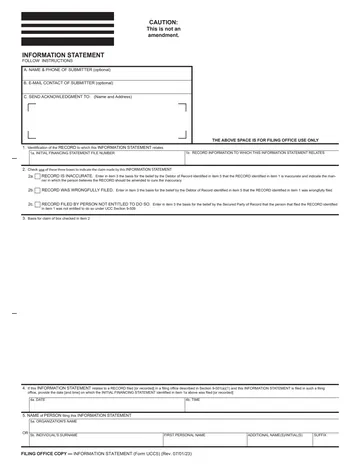
Form UCC5 is the Information Statement in IACA's national set. It prints “(Rev. 07/01/23)” at its foot, with the instructions on page one and the form on page two. Download it from IACA's UCC Forms and Resources page (the 2023 UCC5 PDF). Across the top of the form, in a box of its own: “CAUTION: This is not an amendment.”
It is the uniform Article 9's way for a person to put an objection on the public record next to a filing. The statute behind it is UCC 9-518: “A person may file in the filing office an information statement with respect to a record indexed there under the person’s name if the person believes that the record is inaccurate or was wrongfully filed.” (Del. Code tit. 6, 9-518(a), Delaware's text).
- Who files it. Two kinds of people. The person a record is indexed under (usually the debtor) who believes the record is inaccurate or was wrongfully filed (boxes 2a and 2b), and a secured party of record who believes someone filed a record against its financing statement without the right to (box 2c).
- What it must say. “Always complete items 1 and 5 and either 2a or 2b or 2c.” “Always complete item 3 with the basis for the box marked in item 2.” “You may also be required to complete item 4.”
- Where it goes. To the filing office that holds the record. “Send completed form and any attachments to the filing office, with the required fee.” In Georgia, every filing sits with a clerk of superior court, and “The information statement shall be filed in the filing office of the county where the record was filed.” (O.C.G.A. 11-9-518(a)).
- What it does. It puts your side on the record. It does not end, change or remove the filing: “The filing of an information statement does not affect the effectiveness of an initial financing statement or other filed record.” (Del. Code tit. 6, 9-518(e)).
- Paper or online. IACA's model rule leaves it to each office whether information statements may be filed electronically; the comment says “This option allows states to accept information statements electronically if they choose.” (MARS 100.5). Some offices take it online, as West Virginia does: “A UCC-5 Information Statement may be filed by any authorized parties, if it is believed that a particular record is inaccurate, was wrongfully filed, or filed by an unauthorized party.”
- Fees. Set by each state, from nothing to $50 in the state rows; the table below lists each.
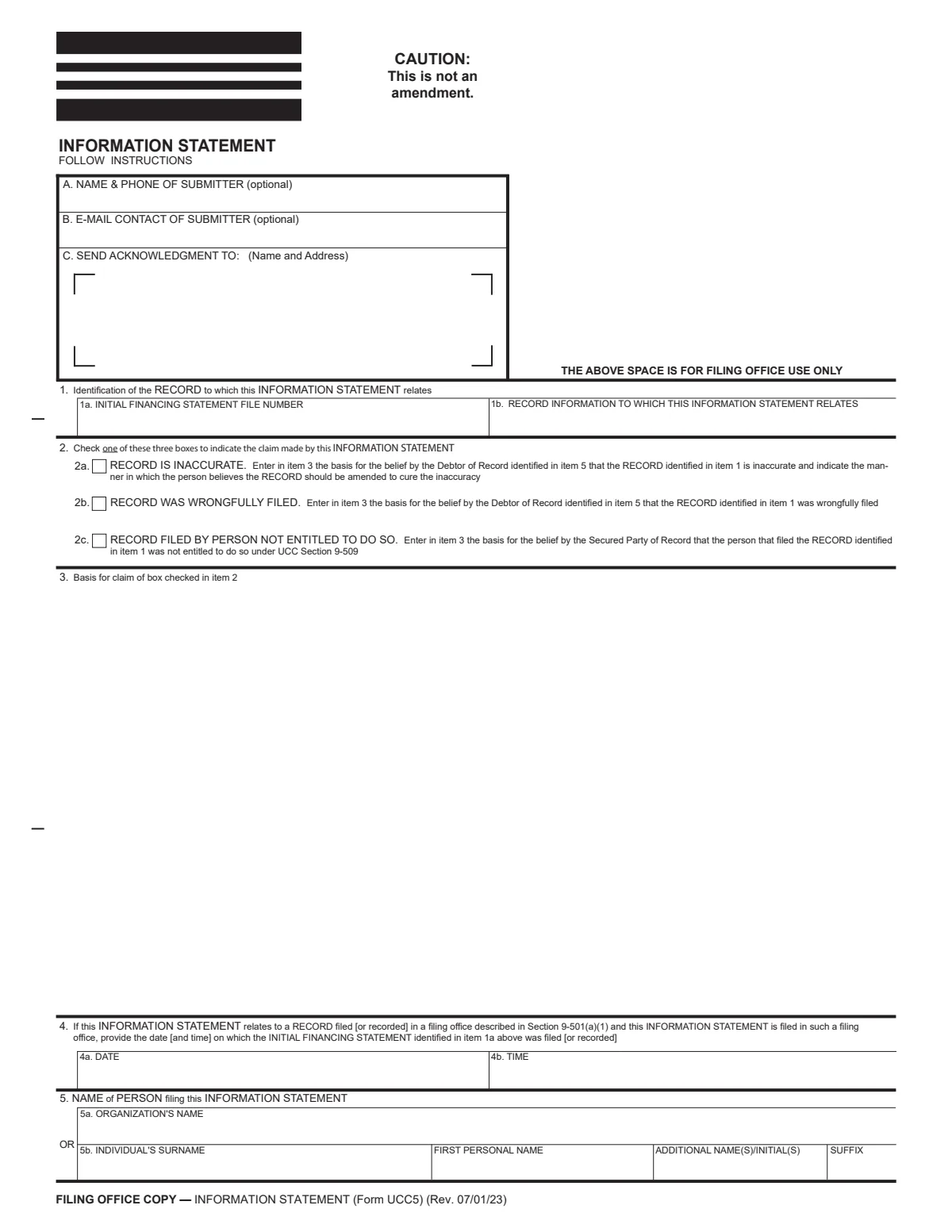
Tap a box once for its note, again to jump to the line. Zoom in to read the small print.
Boxes A to C: the submitter
The lettered boxes work as on the UCC1 and UCC3. In 2023 they changed from filer to submitter (IACA revision guide). The space to the right is for filing office use only.
| Line | Label | What goes there |
|---|---|---|
| A | A. NAME & PHONE OF SUBMITTER (optional) | Optional, as on the other national forms: a contact for the filing office, not part of the claim. |
| B | B. E-MAIL CONTACT OF SUBMITTER (optional) | Optional e-mail contact for the filing office. |
| C | C. SEND ACKNOWLEDGMENT TO: (Name and Address) | Complete it to get the filed copy back with the statement's own file number and filing date. Keep it: it is your proof that your side is on the record. |
Item 1: which record
The instructions put the weight here: “correct identification of the initial record to which this Information Statement relates is crucial”. An information statement is filed against a record the office already holds, so it must point to it the way an amendment does, by the initial financing statement's file number.
| Line | Label | What goes there |
|---|---|---|
| 1a | 1a. INITIAL FINANCING STATEMENT FILE NUMBER | The statute's first requirement: the statement must identify the record by “the file number assigned to the initial financing statement to which the record relates” (Del. Code tit. 6, 9-518(b)(1)(A)). “Enter only one file number.” (instruction 1a). An office refuses an information statement that does not identify the initial financing statement, or that names one whose effectiveness has lapsed (Del. Code tit. 6, 9-516(b)(3)(B)). |
| 1b | 1b. RECORD INFORMATION TO WHICH THIS INFORMATION STATEMENT RELATES | A financing statement can have many records under one file number: the UCC1 and every amendment. Item 1b says which one you dispute. The instructions: “Indicate the type of record to which this Information Statement relates (e.g., Financing Statement or Amendment)”, or add the record's own file number or filing date (instruction 1b). |
Item 2: the claim
Check one box. The first two are the debtor's: the record is wrong, or it should not be there at all. The third is the secured party's, added by the 2010 amendments to Article 9: the ULC's summary says they “authorize the secured party of record to also file an information statement if the secured party believes that an amendment to its financing statement was not authorized”.
UCC 9-509(d)(2), 9-513(c) and 9-518, as enacted (Delaware's text); Form UCC5 (Rev. 07/01/23).
| Line | Label | What goes there |
|---|---|---|
| 2a | 2a. RECORD IS INACCURATE | For the person the record is indexed under. The statement must “provide the basis for the person’s belief that the record is inaccurate and indicate the manner in which the person believes the record should be amended to cure any inaccuracy” (Del. Code tit. 6, 9-518(b)(3)). Use it when a real filing gets a fact wrong: a misspelled name, the wrong address, collateral that was never part of the deal. |
| 2b | 2b. RECORD WAS WRONGFULLY FILED | For the same person, when the record should not exist at all: a filing nobody authorized, or a filing that names you by mistake. The statute: “A person may file in the filing office an information statement with respect to a record indexed there under the person’s name if the person believes that the record is inaccurate or was wrongfully filed.” (Del. Code tit. 6, 9-518(a)). |
| 2c | 2c. RECORD FILED BY PERSON NOT ENTITLED TO DO SO | The secured party's box. A person may file an information statement “if the person is a secured party of record with respect to the financing statement to which the record relates and believes that the person that filed the record was not entitled to do so under Section 9-509(d)” (Del. Code tit. 6, 9-518(c)). The case it was written for: an amendment or termination filed against the wrong file number by someone else's typo. The ULC's summary of the 2010 amendments also notes that “the secured party has no duty to file an information statement, even if it knows of the unauthorized filing”. |
Item 3: the basis
Item 3 is most of the page, and it is the part a searcher, a lender or a court will read. The statute requires a basis for every box, and for box 2a also the correction you believe the record needs.
| Line | Label | What goes there |
|---|---|---|
| 3 | 3. Basis for claim of box checked in item 2 | “Always complete item 3 with the basis for the box marked in item 2.” (page one). Write facts, not conclusions: when you learned of the record, why it is wrong or unauthorized, and for box 2a what the record should say. The statement is public, and in some states the office or a court reads it; North Carolina, for example, requires that an information statement claiming the record should have been refused “shall include a written certification, under oath” (G.S. 25-9-518(b1)). Keep social security numbers and account numbers out. |
Item 4: county real estate records
Most filings are with a Secretary of State, and item 4 stays blank. It applies only where the disputed record sits in the land records of a county.
| Line | Label | What goes there |
|---|---|---|
| 4 | 4. If this INFORMATION STATEMENT relates to a RECORD filed [or recorded] in a filing office described in Section 9-501(a)(1) ... provide the date [and time] (4a. DATE, 4b. TIME) | Only for a record in the county real estate records (a fixture filing, timber or as-extracted collateral). There the statement must also give “the date that the initial financing statement was filed and the information specified in Section 9-502(b)” (Del. Code tit. 6, 9-518(b)(1)(B)). The brackets on the form are for states whose text differs: New York's asks for the “date and time that the initial financing statement was filed” (N.Y. U.C.C. 9-518(b)(1)(B)). “You may also be required to complete item 4.” (page one). |
Item 5: who files it
Item 5 names the person making the claim, and it must match the record. That rule keeps strangers from filing claims against other people's filings: only the person the record is indexed under, or a secured party of record, can file one.
| Line | Label | What goes there |
|---|---|---|
| 5 | 5. NAME of PERSON filing this INFORMATION STATEMENT | Who is making the claim. “This name must be the same name as a Secured Party of Record or the name under which the record is indexed.” (instruction 5). For boxes 2a and 2b that is the name the record is indexed under; for box 2c, a secured party of record. The form has no signature line. |
| 5a | 5a. ORGANIZATION'S NAME | The organization name exactly as the disputed record shows it, even if it is misspelled there; explain the error in item 3. |
| 5b | 5b. INDIVIDUAL'S SURNAME / FIRST PERSONAL NAME / ADDITIONAL NAME(S)/INITIAL(S) / SUFFIX | The individual name exactly as the record shows it, each part in its own box. |
Form UCC5 and instructions (Rev. 07/01/23); Del. Code tit. 6, 9-518; MARS 505.3.3.
What it does and does not do
An information statement is notice, not a cure. The financing statement stays effective, the secured party keeps its rights, and the record stays on the index as before. IACA's model rule for offices says the same: “The filing of an information statement shall have no effect upon the status of any party to the financing statement, the status of the financing statement or the information maintained in the UCC information management system.” (MARS 310). Filing offices tell readers so in plain words:
- Alabama: “The Information Statement does not amend/change any filing/index. It is for informational purposes only.”
- Arizona: “This form will not remove the filing from our system”.
- Vermont: “The Secretary of State does not determine whether the information statement is effective or legitimate.”
- New York: “The filing of the UCC5 Information Statement does not remove the filing but is added to the financing statement record”.
What it does give you is visibility. The statement is linked to the financing statement, and IACA's model search report lists each financing statement “including a listing of all related amendments, information statements, or filing office notices” (MARS 505.3.3). A lender, landlord or buyer who searches your name sees your objection beside the filing. In a few states it also starts something: in Missouri and North Carolina, an information statement alleging a wrongful filing leads to a decision by the Secretary of State, who can cancel the record (see wrongful UCC filings).
Correction statement, statement of claim
The form has had more than one name. Before 2010, Article 9 called it a correction statement; the ULC's summary of the 2010 amendments says “the filing is no longer called a ‘correction statement,’ but is instead referred to as an ‘information statement.’” Most states took the new name. New York did not: its statute still reads “A person may file in the filing office a correction statement with respect to a record indexed there under the person's name” (N.Y. U.C.C. 9-518(a)), and the Department of State posts the national form as the “National Correction Statement (Form UCC5)”. Arizona's page lists it as “UCC 5: Information Request (Correction Statement): allows debtor or secured party to dispute a filing”.
The state rows show the same spread in the names offices give the form they post: Maryland and New York call it a correction statement, and Massachusetts, Oklahoma, South Carolina and West Virginia call it a statement of claim. Whatever the label, it is the same 9-518 filing, and the national UCC5 works wherever the office takes the national forms.
Every state's form and fee
38 offices post an information statement form of their own, linked below as the office names it; others take the national UCC5 or file online only. 24 state rows list a fee. "Not listed" means the state's saved texts do not list a form or a fee of their own; use the national form and ask the office for its fee.
| State | The form as the office posts it | Fee (the state row) |
|---|---|---|
| Alabama | UCC5 | Not listed |
| Alaska | UCC5 Information Statement | UCC5 information statement $10 (11 AAC 05.250; The fee page calls it a Correction Statement) |
| Arizona | UCC5 (2011) UCC5 (2023) | UCC5 $9 |
| Arkansas | UCC5 | UCC5 $6 |
| California | UCC5 | UCC5 $5 online, $10 (1 to 2 pages) or $20 paper |
| Colorado | Information statement (online form instructions) | Information statement (correction) $8 |
| Connecticut | Information Statement | Information statement $50 |
| Delaware | UCC5 Information Statement | Not listed |
| District of Columbia | Not listed | Not listed |
| Florida | Forms list | UCC5 information statement $12 |
| Georgia | Information Statement (UCC5) | UCC5 information statement $25 by statute (GSCCCA page: free if the record is inaccurate, $25 if wrongfully filed) |
| Hawaii | Forms list | Not listed |
| Idaho | UCC-5 Information Statement | UCC-5 $6 (1 to 2 pages) or $12 by statute and rule (fee page: $20, paper form only) |
| Illinois | Information Statement (UCC5) UCC57 Affidavit of Fraudulent Record UCC 58 Payment Cover Sheet (with a UCC 11) | UCC5 information statement $20 |
| Indiana | Not listed | UCC5 information statement $13 online, $12 on paper |
| Iowa | Information Statement (UCC5) | Information statement $10 or $20 |
| Kansas | UCC5 Information Statement | Correction statement $20 (paper only) |
| Kentucky | Information Statement (UCC5) | Paper correction statement $10 or $20 |
| Louisiana | UCC-5 Information Statement | Not listed |
| Maine | UCC-5 Information Statement | Not listed |
| Maryland | UCC5 Correction Statement | Not listed |
| Massachusetts | UCC 5 Statement of Claim | Not listed |
| Michigan | Not listed | No fee for an information statement filed by an individual debtor |
| Minnesota | UCC5 Information Statement | UCC-5 $20 (paper only) |
| Mississippi | Not listed | Not listed |
| Missouri | UCC5 Information Statement | Not listed |
| Montana | Not listed | Not listed |
| Nebraska | UCC5 | Not listed |
| Nevada | UCC5 | Not listed |
| New Hampshire | UCC5 | Not listed |
| New Jersey | Not listed | Not listed |
| New Mexico | Not listed | UCC5 $20 |
| New York | National Correction Statement (Form UCC5) | Not listed |
| North Carolina | Information Statement (UCC-5) | Not listed |
| North Dakota | Not listed | Information statement $40 |
| Ohio | Not listed | Not listed |
| Oklahoma | UCC5 Statement of Claim | Not listed |
| Oregon | UCC5 Information Statement | UCC-5 information statement $15 |
| Pennsylvania | UCC5 Information Statement | UCC-5 $84 (a Correction Statement on the fee page, an information statement in the 2026 report) |
| Rhode Island | Not listed | Not listed |
| South Carolina | UCC5 Statement of Claim | Not listed |
| South Dakota | Not listed | Not listed |
| Tennessee | UCC-5 Information Statement | UCC-5 information statement $15 (fee page) |
| Texas | UCC5 Information Statement | Not listed |
| Utah | UCC-5 Information Statement | UCC-5 free |
| Vermont | Not listed | Not listed |
| Virginia | Not listed | UCC-5 information statement $20 (fee page) |
| Washington | UCC5 Information Statement | Not listed |
| West Virginia | UCC-5 Statement of Claim (online) | Not listed |
| Wisconsin | Forms list | Not listed |
| Wyoming | UCC-5 Information Statement | UCC5 $7.50 online, $15 paper |
Some fee lines differ by the claim. Georgia's statute sets $25, while the clerks' page lists no fee for an inaccurate record and $25 for one wrongfully filed; the statute governs (see the Georgia page). Michigan charges nothing when an individual debtor files. Each state page has the office's full fee schedule.
The UCC5 and the other tools
For a business owner who finds a filing that should not be there, the information statement is one tool of several, and rarely the one that ends the problem:
- The 20-day demand. When there is no debt or commitment left, or the filing was never authorized, the secured party must file or send a termination “within 20 days after a secured party receives a signed demand from a debtor” (Del. Code tit. 6, 9-513(c)). Use the termination demand letter; the steps are on how to remove a UCC lien.
- A debtor-authorized termination. If the secured party does not act, the debtor may file a UCC3 termination itself, checking the debtor box in item 9 (see the UCC3 page).
- The state's own procedure. Many states add an affidavit, an office review or a court process for fraudulent filings, some of which end the filing. They are listed state by state on wrongful UCC filings.
- The UCC5. Filed alongside any of these, it tells every searcher your side while the rest runs.
Mistakes the form invites
- Treating it as a termination. The form says it is not an amendment. The filing stays effective.
- Two boxes in item 2. Check one. A record that is both wrong and unauthorized is a 2b claim; explain the rest in item 3.
- A name in item 5 that differs from the record. Use the name the record is indexed under, even if it is misspelled there.
- The wrong file number. Use the initial financing statement's number in 1a, and identify the exact record in 1b.
- A lapsed filing. An office refuses an information statement about a financing statement whose effectiveness has lapsed.
- Accusations instead of facts. The statement is public. State what happened and why the record is wrong.
How it connects
The borrower's side is on what a UCC lien is, how to remove a UCC lien and wrongful UCC filings; payoff questions are on a UCC lien after loan payoff. To find the file number, search the state's index from its state page or follow the UCC lien search guide. The other national forms are on the forms hub.
Common questions
Does filing a UCC5 remove a UCC lien?
No. The form says it is not an amendment, and the statute says filing an information statement does not affect the effectiveness of the financing statement. It adds your statement to the record so searchers see it.
Who can file an information statement?
The person a record is indexed under, usually the debtor, if it believes the record is inaccurate or was wrongfully filed; and a secured party of record that believes someone without authority filed a record against its financing statement.
What is the difference between a UCC5 and a UCC3 termination?
A UCC3 termination, filed by the secured party or in the narrow case allowed by a debtor, ends the filing's effectiveness. A UCC5 only puts a claim on the record. A business that wants a filing gone starts with the signed demand for a termination.
Is a correction statement the same thing?
Yes. Before the 2010 amendments, Article 9 called it a correction statement, and New York's statute still does. Some offices call their form a statement of claim. All are the 9-518 filing the national UCC5 is built for.
How much does a UCC5 cost?
It depends on the state: from no fee to $50 in the state rows, and some states charge differently for paper and online filing or by the kind of claim. The table on this page lists each state's fee where its texts give one.
Can I file a UCC5 online?
In some states. IACA's model rules let each office decide whether to accept information statements electronically; Colorado and West Virginia, for example, take them online. Others take the paper form only.
Sources
- IACA, Information Statement (Form UCC5) (Rev. 07/01/23), with its instructions
- IACA, UCC Forms and Resources; IACA, UCC Forms Revision Guide (2023)
- IACA, Model Administrative Rules (2024 ed.): rules 100.5, 310 and 505.3.3
- Delaware Code, title 6, Article 9, Part 5 (9-516(b)(3)(B), 9-518), the uniform wording as Delaware enacted it
- Uniform Law Commission, summary of the 2010 amendments to UCC Article 9
- N.Y. U.C.C. 9-518; New York Department of State, UCC forms; Arizona Secretary of State, UCC; Vermont Secretary of State, UCC liens
- Alabama, Georgia, New York, North Carolina, West Virginia and the other states: each office's information statement texts and fees, cited on its state page