- At a glance
- The form, with hotspots
- Item 9: the cross-reference
- Item 10: one more debtor
- Item 11: one more secured party, or the assignor
- Item 12: more collateral
- Items 13 to 16: real estate records
- Item 17: state requirements
- Pages, fees and online filing
- Offices that post the form
- Mistakes the form invites
- How it connects
- Common questions
- Sources
- Who completes it
- The secured party or its filer, with the UCC1
- Filed with
- The same office as the UCC1, as one record
- Form revision
- Rev. 07/01/2023 (IACA)
- Pages
- Instructions on page 1, the form on page 2
- Items
- 9 to 17
At a glance
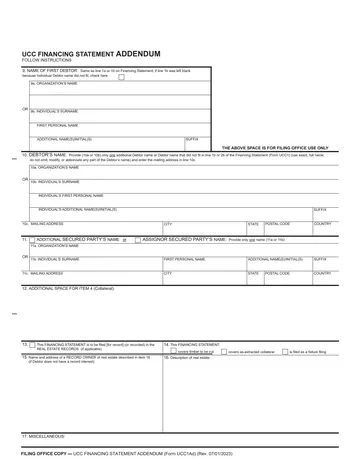
Form UCC1Ad is the UCC Financing Statement Addendum in the national set published by the International Association of Commercial Administrators (IACA), the association of state filing officials. The current version prints “(Rev. 07/01/2023)” at its foot. Page one is the instructions and page two is the form. Download it from IACA's UCC Forms and Resources page (the 2023 UCC1Ad PDF).
The addendum never travels alone. It is extra space for a UCC1 financing statement, and its items pick up where the UCC1 stops: the UCC1 ends at item 8, the addendum runs from item 9 to item 17. Alabama's forms page says it is “always filed with a UCC1”.
- What it is for. Five jobs: one more debtor (item 10), one more secured party or the assignor of a loan assigned before filing (item 11), more room for the collateral description (item 12), the real estate details a fixture filing, a timber filing or an as-extracted collateral filing needs (items 13 to 16), and a state's own extra requirements (item 17).
- Who completes it. The secured party or its filer, along with the UCC1. Like the UCC1, it has no signature line.
- Where it goes. With the UCC1, to the same filing office, as part of one record. For a real estate related filing, that office is the county office where a mortgage on the land is recorded, not the Secretary of State.
- Is it a statutory form? Where a state enacted the uniform form section, yes. California's office says “Section 9521 of the California Uniform Commercial Code contains the statutorily mandated UCC Financing Statement (Form UCC1), UCC Financing Statement Addendum (Form UCC1Ad), UCC Financing Statement Amendment (Form UCC3) and UCC Financing Statement Amendment Addendum (Form UCC3Ad).” An office that accepts written records “may not refuse to accept a written initial financing statement in the following form and format except for a reason set forth in” the refusal grounds (Del. Code tit. 6, 9-521(a)).
- What the office checks. Not much. In IACA's model rules, “the filing office does not determine the legal sufficiency of the record” (MARS 200). The office files what it receives; an error on the addendum stays on the record.
Tap a box once for its note, again to jump to the line. Zoom in to read the small print.
Item 9: the cross-reference
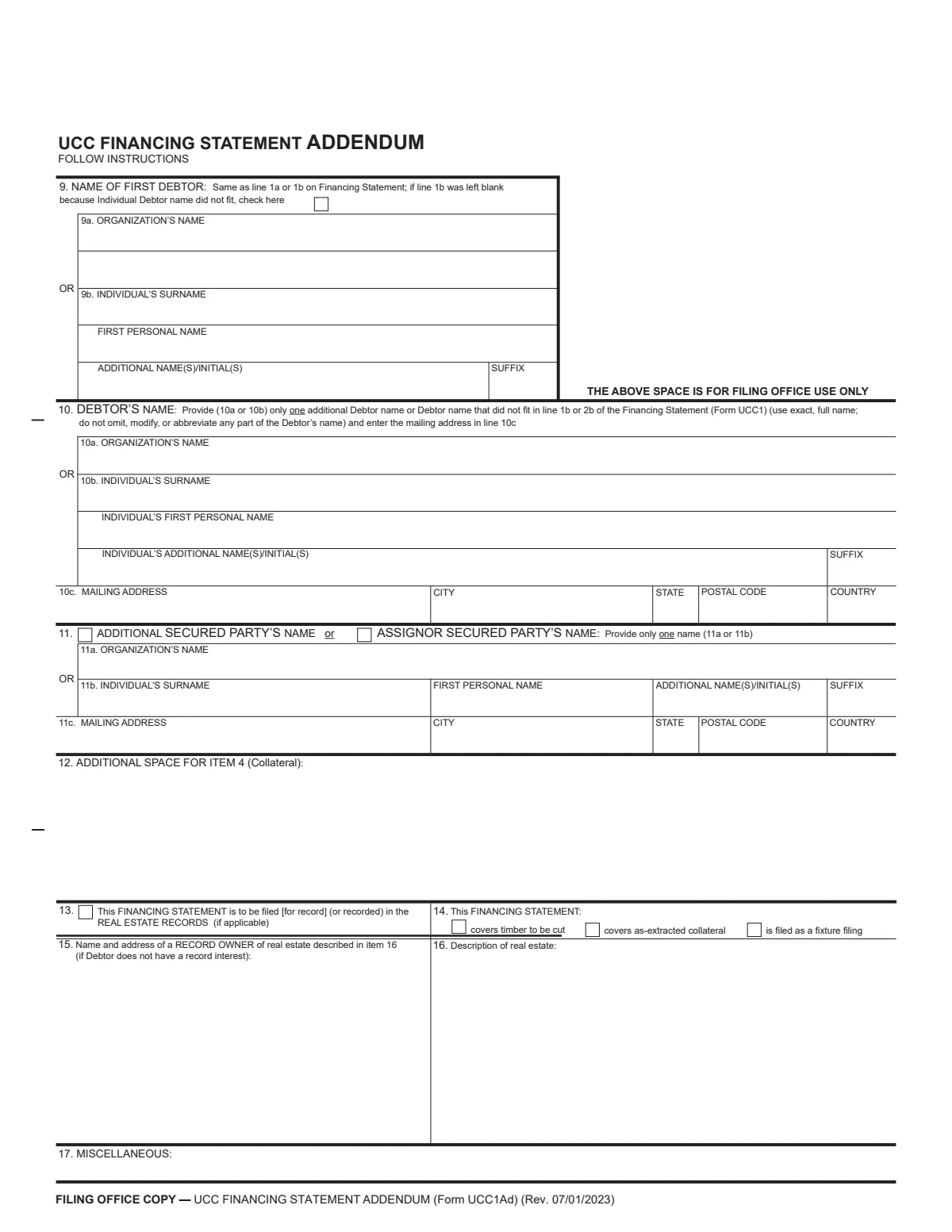
An addendum page can be separated from its UCC1 in the mail room or on a scanner. Item 9 is how it finds its way back: the first debtor's name from the UCC1, repeated. The large blank space to the right of item 9 is for filing office use only.
| Line | Label | What goes there |
|---|---|---|
| 9 | 9. NAME OF FIRST DEBTOR: Same as line 1a or 1b on Financing Statement; if line 1b was left blank because Individual Debtor name did not fit, check here | A cross-reference, not a new party. The instructions: “The name will not be indexed as a separate debtor.” Copy the name from the UCC1 exactly, so the addendum page stays tied to its financing statement in the office's records and on any copy a searcher orders. The check box pairs with the box on the UCC1: “If the box in item 1 of the Financing Statement (Form UCC1) was checked because Individual Debtor name did not fit, the box in item 9 of this Addendum should be checked.” (instruction 9). |
| 9a | 9a. ORGANIZATION'S NAME | The organization name as it appears in line 1a of the UCC1, letter for letter, ending included. |
| 9b | 9b. INDIVIDUAL'S SURNAME / FIRST PERSONAL NAME / ADDITIONAL NAME(S)/INITIAL(S) / SUFFIX | The individual name as it appears in line 1b. Where line 1b was left blank because the name was too long, enter as much of it as fits here and check the box in item 9; the full name goes in item 10. |
Item 10: one more debtor
Item 10 holds one debtor name, organization or individual, with its own mailing address. It follows the same name rules as items 1 and 2 of the UCC1, because to the office and to a searcher it is the same kind of entry: every debtor name on the financing statement is indexed and searchable. “Each debtor name provided by the initial financing statement shall be indexed in the UCC information management system” (MARS 306.2).
Form UCC1 instructions 1 to 3; Form UCC1Ad instructions 9 to 11 (Rev. 07/01/2023); Form UCC1AP; MARS 302.3.
| Line | Label | What goes there |
|---|---|---|
| 10 | 10. DEBTOR'S NAME: Provide (10a or 10b) only one additional Debtor name or Debtor name that did not fit in line 1b or 2b | Item 10 has two uses. It holds “only one additional Debtor name or Debtor name that did not fit in line 1b or 2b of the Financing Statement” (item 10). For a third debtor and beyond, the instructions send you to another addendum or to the additional party form (Form UCC1AP), which holds three debtors a page. The uniform text allows as many as the deal needs: “A financing statement may provide the name of more than one debtor and the name of more than one secured party.” (Del. Code tit. 6, 9-503(e)). For the name that did not fit, IACA's model rule tells offices not to refuse a paper UCC1 that lacks debtor information in item 1 or 2 “if the record includes an addendum that provides debtor information in item 10” (MARS 302.3). |
| 10a | 10a. ORGANIZATION'S NAME | The added debtor's name exactly as its public organic record shows it, with the corporate ending, under the same rules as line 1a of the UCC1. To confirm an entity's exact registered name and status, use the state's business entity search: see how to check a company's good standing on goodstandingrules.com. |
| 10b | 10b. INDIVIDUAL'S SURNAME / INDIVIDUAL'S FIRST PERSONAL NAME / INDIVIDUAL'S ADDITIONAL NAME(S)/INITIAL(S) / SUFFIX | A natural person, including a sole proprietor, in four boxes. Which name counts is the state's rule (Alternative A, the license name, or Alternative B); see UCC debtor name rules and the debtor name checker. An office refuses a record that names an individual debtor if “the record does not identify the debtor’s surname” (Del. Code tit. 6, 9-516(b)(3)(C)). |
| 10c | 10c. MAILING ADDRESS / CITY / STATE / POSTAL CODE / COUNTRY | Required for every debtor name. An office refuses an initial financing statement that does not “provide a mailing address for the debtor” (Del. Code tit. 6, 9-516(b)(5)(A)). Because “If a record communicated to a filing office provides information that relates to more than one debtor, this part applies as to each debtor separately.” (Del. Code tit. 6, 9-520(d)), a missing address in item 10c puts the added debtor at risk, not the whole filing. |
Item 11: one more secured party, or the assignor
The UCC1 has room for one secured party in item 3. A second lender in a shared deal, or the original lender in a loan sold before the filing, goes in item 11. The two check boxes say which: an additional secured party of record, or the assignor secured party.
| Line | Label | What goes there |
|---|---|---|
| 11 | 11. ADDITIONAL SECURED PARTY'S NAME or ASSIGNOR SECURED PARTY'S NAME: Provide only one name (11a or 11b) | Two different uses behind two check boxes. An additional secured party becomes a secured party of record like the one in item 3: “Each secured party named on an initial financing statement shall be indexed as a secured party of record.” (MARS 306.1). The assignor box is for a loan assigned before the filing: the UCC1 may name the assignee as secured party “by providing the name and mailing address of the assignee as the name and address of the secured party” (Del. Code tit. 6, 9-514(a)), and then “filer may enter Assignor Secured Party’s name and mailing address in item 11” (instruction 11). The assignor's name is optional there; the assignee in item 3 is the secured party of record. |
| 11a | 11a. ORGANIZATION'S NAME | The added secured party or the assignor, if an organization. A representative, such as an agent for a group of lenders, may be named. |
| 11b | 11b. INDIVIDUAL'S SURNAME / FIRST PERSONAL NAME / ADDITIONAL NAME(S)/INITIAL(S) / SUFFIX | The added secured party or the assignor, if a natural person. |
| 11c | 11c. MAILING ADDRESS / CITY / STATE / POSTAL CODE / COUNTRY | Give it for every secured party named. An office refuses a record that “does not provide a name and mailing address for the secured party of record” (Del. Code tit. 6, 9-516(b)(4)). Searchers and the debtor use this address to reach the secured party. |
Item 12: more collateral
Item 4 of the UCC1 is a single box. When the description runs longer, it continues in item 12 or on attached pages. The description is the secured party's legal choice, usually matching the security agreement.
| Line | Label | What goes there |
|---|---|---|
| 12 | 12. ADDITIONAL SPACE FOR ITEM 4 (Collateral) | Continue the collateral description from item 4 of the UCC1 here, or attach pages and incorporate them by reference ("See Exhibit A"). “Do not include social security numbers or other personally identifiable information.” (item 12). The financing statement may simply say it covers “an indication that the financing statement covers all assets or all personal property” (Del. Code tit. 6, 9-504); a long schedule of equipment by serial number is the usual reason to reach item 12. See the collateral description guide. |
Items 13 to 16: real estate records
Most UCC1s go to the Secretary of State and never use items 13 to 16. They matter for three kinds of filing that are recorded with the land: a fixture filing (goods that are or will become fixtures), timber to be cut, and as-extracted collateral. For those, the UCC1's own instructions say to attach the addendum and complete items 13, 14, 15 and 16, and to consult the state's law for the filing location. Each item answers one requirement of the statute:
| What the statute requires (9-502(b), Delaware's text) | Where it goes on the addendum |
|---|---|
| Indicate that it covers this type of collateral | Item 14: timber to be cut, as-extracted collateral or fixture filing |
| Indicate that it is to be filed in the real property records | Item 13 |
| A description of the real property sufficient for constructive notice | Item 16 (an exhibit if long) |
| The name of a record owner, if the debtor has no interest of record | Item 15 |
Form UCC1Ad instructions 13 to 16 (Rev. 07/01/2023); Del. Code tit. 6, 9-501(a)(1) and 9-502(b).
| Line | Label | What goes there |
|---|---|---|
| 13 | 13. This FINANCING STATEMENT is to be filed [for record] (or recorded) in the REAL ESTATE RECORDS (if applicable) | Check it for a filing in the land records. Delaware's text lists what such a filing must add to the usual three elements, starting with that it “indicate that it is to be filed in the real property records” (Del. Code tit. 6, 9-502(b)(2)). The filing goes to “the office designated for the filing or recording of a record of a mortgage on the related real property” (Del. Code tit. 6, 9-501(a)(1)), usually a county recorder or clerk, not the Secretary of State. |
| 14 | 14. This FINANCING STATEMENT: covers timber to be cut / covers as-extracted collateral / is filed as a fixture filing | Check the box for the kind of collateral. The statute requires the financing statement to “indicate that it covers this type of collateral” (Del. Code tit. 6, 9-502(b)(1)). In Delaware's definitions, as-extracted collateral includes “accounts arising out of the sale at the wellhead or minehead of oil, gas, or other minerals” (Del. Code tit. 6, 9-102(a)(6)), as well as the minerals themselves; a fixture filing covers goods that are or will become fixtures. See fixture filings. |
| 15 | 15. Name and address of a RECORD OWNER of real estate described in item 16 (if Debtor does not have a record interest) | “If the Debtor does not have an interest of record, enter the name and address of the record owner in item 15.” (instruction 13 to 16). The statute requires the record owner's name only “if the debtor does not have an interest of record in the real property” (Del. Code tit. 6, 9-502(b)(4)). A tenant who installs equipment in leased space is the usual case: the landlord is the record owner. |
| 16 | 16. Description of real estate | A description “sufficient to give constructive notice of a mortgage under the law of this State if the description were contained in a record of the mortgage of the real property” (Del. Code tit. 6, 9-502(b)(3)). The local office refuses a record where “the record does not provide a sufficient description of the real property to which it relates” (Del. Code tit. 6, 9-516(b)(3)(D)). The legal description from the deed or recorded mortgage is the safe source; put it on an exhibit if it is long. |
The land records office indexes a real estate related filing the way it indexes a mortgage: “under the names of the debtor and of each owner of record shown on the financing statement as if they were the mortgagors under a mortgage of the real property described” (Del. Code tit. 6, 9-519(d)(1)). That is why the record owner's name in item 15 matters: a title searcher finds the filing under the owner's name in the land records.
Where the filing goes is a state rule, and the state rows show how it varies. New York's filing guide says the local office “This is the office of the county clerk or New York City Register.” Georgia and Louisiana file every financing statement locally. A few examples:
| State | Where real estate related filings go (the state row) |
|---|---|
| Georgia | Every financing statement is filed with a county clerk of superior court and indexed statewide; as-extracted collateral, growing crops, timber to be cut and fixture filings go to the office for real estate mortgage records (O.C.G.A. 11-9-501(a)(1)) |
| Louisiana | All UCC filings, including fixture filings and as-extracted collateral, go to any parish clerk of court (one parish perfects statewide); UCC-3s go to the parish of the original filing. Farm products: central registry forms UCC-1F and UCC-3F, filed with the clerks. Titled vehicles: Office of Motor Vehicles; titled vessels: Department of Wildlife and Fisheries. |
| New York | County clerk (city register in Bronx, Kings, New York and Queens): fixture filings, as-extracted collateral, timber to be cut and cooperative interests; block indexing in New York City, Nassau and Onondaga. No farm products central filing system listed. |
| Pennsylvania | Fixture filings, as-extracted collateral and timber to be cut: the county office that records mortgages on the real property ($95 county fee by regulation). Transmitting utilities: Secretary of the Commonwealth. |
| Vermont | Fixture filings, as-extracted collateral and timber to be cut: the office where a mortgage on the real property is recorded. Farm products: USDA lists Vermont's central filing system as certified under the Food Security Act (7/13/87, all products). |
| Delaware | Fixture filings, as-extracted collateral and timber to be cut: county real property records (the office where mortgages are recorded); the county tax parcel number may serve as the real property description. |
One exception runs the other way. For a transmitting utility (in Delaware's definitions, a person primarily engaged in, among other things, “transmitting goods by pipeline or sewer” or operating a railroad (Del. Code tit. 6, 9-102(a)(81))), the filing goes to the Secretary of State, and “The financing statement also constitutes a fixture filing as to the collateral indicated in the financing statement which is or is to become fixtures.” (Del. Code tit. 6, 9-501(b)). Delaware also lets a filer meet the county's recording rule by placing the county tax parcel number in item 4 of the UCC1 (Del. Code tit. 6, 9-516(c)(3)).
Item 17: state requirements
The national form is built for the uniform text. Item 17 exists because some states ask for more, and the national form has no box for it.
| Line | Label | What goes there |
|---|---|---|
| 17 | 17. MISCELLANEOUS | The space IACA leaves for state law. The instructions say “some states have non-uniform requirements” and that item 17 or an attached page incorporated by reference may be used to meet them; otherwise, leave it blank (instruction 17). Item 17 is not a place for an extra debtor, secured party or collateral: those have their own items, and an office indexes names only from the name boxes. |
Two examples from the state pages. Tennessee requires a statement of the maximum principal indebtedness for its recording tax, and its office says the statement goes “on either the face of the instrument or on an attached sworn statement”; it names no box, so item 17 or an attached sworn statement both meet it. Florida's clerks and filing officers will not accept a financing statement “unless there appears thereon a notation that the taxes required by this chapter have been paid” (Fla. Stat. 201.22); Florida's texts name no box either. New York handles its own extra (security interests in cooperative apartments) with a separate state form, the New York cooperative addendum (Form UCC1CAd), not with item 17. See the Tennessee, Florida and New York pages.
Pages, fees and online filing
Many offices charge nothing for the addendum itself. Alaska's office puts it plainly: “UCC Central File does not charge any additional fees for additional pages or attachments. This also applies to UCC addendums, adding additional secured parties or debtors.” Others charge by the page or by the name, so a long collateral exhibit or an extra debtor can raise the fee. The state rows say what 28 jurisdictions charge (or that they charge nothing) for addenda and pages:
| State | What the row says about addenda, attached pages and extra pages |
|---|---|
| Alaska | No fees for added pages, attachments or parties; The fee page calls it a Correction Statement) |
| Arizona | Addenda and additional party forms no fee |
| Arkansas | Addenda and additional party pages $0.50 |
| California | UCC5 $5 online, $10 (1 to 2 pages) or $20 paper |
| Connecticut | No page or added-name fee |
| Florida | $3 per added page; $5 for a nonapproved form (registry fee page: UCC1 $40 and UCC3 $17 on other than the approved forms) |
| Georgia | No added page charge (attachments are part of the $25 filing); UCC5 information statement $25 by statute (GSCCCA page: free if the record is inaccurate, $25 if wrongfully filed) |
| Hawaii | No addendum or page fee up to 50 pages |
| Idaho | $20 manual processing fee on paper forms (fee page); Attachments only on paper; UCC-5 $6 (1 to 2 pages) or $12 by statute and rule (fee page: $20, paper form only) |
| Illinois | No page or added-name fee |
| Indiana | No page or added-name fee (the number of names does not affect the fee) |
| Iowa | Paper filings of 3 or more pages $20 instead of $10 |
| Kansas | $1 per page after 10 pages |
| Kentucky | Paper over 2 pages $20 instead of $10; Attachments cannot be filed online |
| Louisiana | Added debtor name $5 plus $5 prepaid termination by statute (fee page: $10 each); Pages over 10 $5 each by statute (fee page: attachments $2 each) |
| Michigan | No page or added-name fee |
| Minnesota | No added-name or page fee (flat $20) |
| Mississippi | $3 if attachments and $4 per added debtor on mailed filings |
| Montana | No page or added-name fee; Non-standard search $5 (fee page) |
| Nebraska | No page or added-name fee |
| New Hampshire | Expedite by rule $35 same day, $25 within 24 hours (forms page: $50 walk-in same day, immediate time) |
| New Jersey | No page or added-name fee |
| Oregon | Addendum and additional party forms no charge |
| Pennsylvania | Attached pages no charge; UCC-5 $84 (a Correction Statement on the fee page, an information statement in the 2026 report) |
| Tennessee | UCC-5 information statement $15 (fee page) |
| Utah | Non-national form pages charged at $12 per page |
| Virginia | No page or expedite fee in the fee rule; UCC-5 information statement $20 (fee page) |
| Washington | $1 per added page (online PDF attachments; Third and later paper pages) |
Fees for added debtor names are on the UCC1AP page; every state's UCC-1 fee is in the UCC filing fees by state table and the fee finder.
Online, the addendum disappears into the system's screens: an online filing asks for added debtors, secured parties and collateral in its own fields, and some systems take an attached PDF. 11 jurisdictions no longer take paper filings from the public (Colorado, Delaware, Michigan, Montana, New Jersey, New Mexico, North Dakota, Ohio, Texas, Virginia and West Virginia), so there the form is only a worksheet. The rows above show the exceptions that run the other way, such as offices where attachments go only on paper.
Offices that post the form
36 offices post the addendum on their own pages, most as a copy of the national form, a few as their own version. The link goes to the copy the office posts; where it is older than 2023, check the office's rules on form versions on its state page and the forms hub.
Mistakes the form invites
- A different name in item 9. Item 9 must repeat item 1 of the UCC1 exactly. It is a cross-reference; a variation here does not add a debtor and only confuses the record.
- Putting a debtor in item 17 or item 12. Only the name boxes are indexed. A debtor written into the collateral or miscellaneous space is not a debtor a searcher will find.
- Two names in item 10 or item 11. One name per item. Use another addendum or the UCC1AP for more.
- Forgetting item 10c. Every debtor name needs its own mailing address.
- Items 13 to 16 on a central filing. The real estate items are for a filing in the land records. A UCC1 sent to the Secretary of State is not a fixture filing, though the uniform text sends goods that are or will become fixtures there when the filing “is not filed as a fixture filing” (Del. Code tit. 6, 9-501(a)(2)).
- A loose description in item 16. The county refuses a record whose real estate description it cannot use; copy the legal description from the land records.
- Personal identifiers. No social security numbers in items 12, 15, 16 or 17, or anywhere else on the form.
How it connects
The addendum is part of the UCC1 financing statement; the rules behind its items are on the UCC-1 guide, the debtor name rules, where to file, collateral description and fixture filings. For more parties than one addendum holds, use the UCC1AP additional party form. Later changes go on the UCC3, with the UCC3Ad amendment addendum for a real estate related filing. All the national forms are on the forms hub.
Common questions
When do I need the UCC1Ad?
When the UCC1 runs out of room: a third debtor, a second secured party, the assignor of a loan assigned before filing, a long collateral description, or a fixture, timber or as-extracted collateral filing in the land records. Also when an individual debtor's name will not fit in line 1b.
Is the debtor in item 9 indexed twice?
No. Item 9 repeats the first debtor's name from the UCC1 only to tie the pages together. The instructions say it will not be indexed as a separate debtor.
Can I file the addendum by itself?
No. It is filed with a UCC1 as part of the same record. To add a debtor or collateral to a financing statement already on file, use a UCC3 amendment, with the UCC3Ad or UCC3AP if it needs more room.
Do I need items 13 to 16 for equipment in a leased building?
Only if you are making a fixture filing in the county land records. A UCC1 filed with the Secretary of State covers the equipment as goods without them. If you do make a fixture filing and the debtor is a tenant, the landlord goes in item 15 as the record owner.
Does the addendum cost extra?
Usually not, but some offices charge per page or per added debtor name over a set number. The table on this page lists the charges the state rows show.
What goes in item 17?
Anything a state's own law requires that the national form has no box for, such as Tennessee's indebtedness statement for its recording tax. Otherwise leave it blank.
Sources
- IACA, UCC Financing Statement Addendum (Form UCC1Ad) (Rev. 07/01/2023), with its instructions
- IACA, UCC Financing Statement (Form UCC1) (Rev. 07/01/2023), instructions 1 to 4
- IACA, UCC Forms and Resources
- IACA, Model Administrative Rules (2024 ed.): rules 200, 302.3, 306.1 and 306.2
- Delaware Code, title 6, Article 9, Part 5 (9-501, 9-502, 9-503(e), 9-504, 9-514(a), 9-516, 9-519(d), 9-520(d), 9-521), the uniform wording as Delaware enacted it
- California Secretary of State, UCC FAQs; Alabama Secretary of State, UCC downloads; Alaska Recorder's Office, UCC FAQ
- New York Department of State, UCC filing guide; New York Department of State, UCC forms
- Tennessee Secretary of State, UCC FAQs; Fla. Stat. 201.22
- Each state's forms, fees and real estate filing offices: the state pages, from each office's own pages