- Who completes it
- Whoever files the UCC3, usually the secured party of record
- Filed with
- The office that holds the financing statement, with the UCC3
- Form revision
- Rev. 07/01/23 (IACA)
- Room per copy
- 3 debtors and 2 secured parties or assignors
- Items
- 19 to 26
At a glance
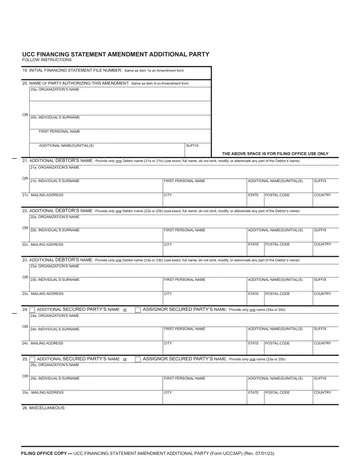
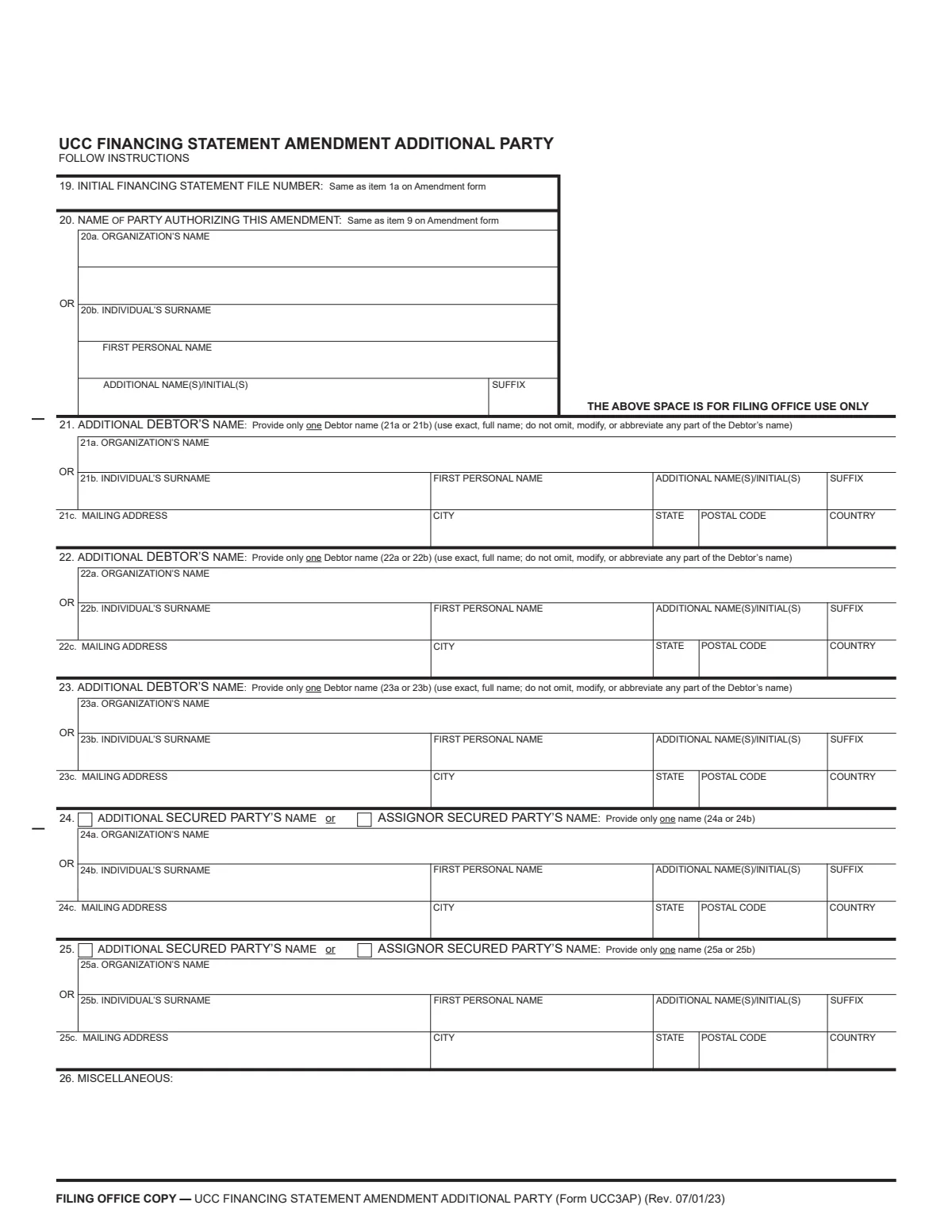
Form UCC3AP is the UCC Financing Statement Amendment Additional Party form in IACA's national set. It prints “(Rev. 07/01/23)” at its foot, with the instructions on page one and the form on page two. Download it from IACA's UCC Forms and Resources page (the 2023 UCC3AP PDF).
It does for a UCC3 what the UCC1AP does for a UCC1. The instructions: “Use this form (multiple copies if needed) to continue adding additional Debtor or Secured Party names as needed when filing a UCC Financing Statement Amendment (Form UCC3).” Each copy holds three debtors (items 21 to 23) and two secured parties or assignors (items 24 and 25), numbered on from the UCC3 and its addendum.
- When it is needed. When an amendment adds or assigns to more parties than item 7 of the UCC3 holds. The UCC3 instructions: “For additional Debtors or Secured Parties, attach Amendment Additional Party (Form UCC3AP), using correct name format.”
- Who completes it. The party filing the UCC3, usually the secured party of record or its filer. The amendment itself, not this page, carries the authority (item 9 of the UCC3).
- Where it goes. With the UCC3, to the office that holds the financing statement, as one record.
- Only for adding. The UCC3AP has boxes for names to add, not for names to delete or change. Deletions and changes use items 5 and 6 of the UCC3, where item 6 holds one current record name.
- Fees. Some offices charge per added debtor name; see the table on the UCC1AP page. Online systems take added parties in their own screens; 11 jurisdictions take amendments online only.
Tap a box once for its note, again to jump to the line. Zoom in to read the small print.
Form UCC3 instructions 3, 5 to 7; Form UCC3AP instructions 19 to 26 (Rev. 07/01/23); Del. Code tit. 6, 9-509(a) and 9-512(e).
Items 19 and 20: tying it to the UCC3
Items 19 and 20 repeat the UCC3's file number and authorizing party, as items 11 and 12 do on the amendment addendum. The space to their right is for filing office use only.
| Line | Label | What goes there |
|---|---|---|
| 19 | 19. INITIAL FINANCING STATEMENT FILE NUMBER: Same as item 1a on Amendment form | The instructions: “Enter file number of initial financing statement as shown in item 1a of Amendment (Form UCC3)” (instruction 19). The amendment and every page attached to it must point to the initial financing statement, not to an earlier amendment. |
| 20 | 20. NAME OF PARTY AUTHORIZING THIS AMENDMENT: Same as item 9 on Amendment form | “Enter information exactly as shown in item 9 on Amendment (Form UCC3).” (instruction 20). A cross-reference; the authority itself is shown in item 9 of the UCC3. |
| 20a | 20a. ORGANIZATION'S NAME | The authorizing organization's name as in item 9a. |
| 20b | 20b. INDIVIDUAL'S SURNAME / FIRST PERSONAL NAME / ADDITIONAL NAME(S)/INITIAL(S) / SUFFIX | The authorizing individual's name as in item 9b. |
Items 21 to 23: added debtors
An added debtor is a new entry in the index, under its own name. The usual reasons: an affiliate joins the loan as a guarantor that pledges its assets, a new entity takes over the business, or a co-borrower is added after closing. In each case the new debtor has to authorize the filing; the secured party cannot add it alone.
Form UCC3 instruction 5; Form UCC3AP instructions 19 to 23 (Rev. 07/01/23); Del. Code tit. 6, 9-509(a) and 9-512(d).
| Line | Label | What goes there |
|---|---|---|
| 21 | 21. ADDITIONAL DEBTOR'S NAME: Provide only one Debtor name (21a or 21b) (use exact, full name; do not omit, modify, or abbreviate any part of the Debtor's name) | Items 21 to 23 follow instruction 1 of the UCC1: the same name rules as an original debtor. An added debtor needs its own authorization: a person may file an “amendment that adds a debtor to a financing statement only if” the debtor authorizes it, in a signed record or by signing a security agreement (Del. Code tit. 6, 9-509(a) and (b)). A secured party's authority alone is not enough. |
| 21a | 21a. ORGANIZATION'S NAME | The added debtor's exact registered name. A debtor that merged into or became a new entity may need its own entry here; see UCC debtor name rules on name changes and new debtors. |
| 21b | 21b. INDIVIDUAL'S SURNAME / FIRST PERSONAL NAME / ADDITIONAL NAME(S)/INITIAL(S) / SUFFIX | An added individual debtor under the state's Alternative A or B rule. An office refuses an amendment adding an individual debtor where “the record does not identify the debtor’s surname” (Del. Code tit. 6, 9-516(b)(3)(C)). |
| 21c | 21c. MAILING ADDRESS / CITY / STATE / POSTAL CODE / COUNTRY | Required. The refusal grounds apply “in the case of an initial financing statement or an amendment that provides a name of a debtor which was not previously provided in the financing statement to which the amendment relates, the record does not” provide a mailing address for the debtor or indicate whether it is an individual or an organization (Del. Code tit. 6, 9-516(b)(5)). |
| 22 | 22. ADDITIONAL DEBTOR'S NAME (22a ORGANIZATION'S NAME or 22b INDIVIDUAL'S NAME; 22c MAILING ADDRESS) | A second added debtor on the page, completed like item 21. |
| 23 | 23. ADDITIONAL DEBTOR'S NAME (23a ORGANIZATION'S NAME or 23b INDIVIDUAL'S NAME; 23c MAILING ADDRESS) | A third added debtor on the page. For more, attach another copy and start again at item 21. |
Items 24 and 25: added secured parties and assignors
Items 24 and 25 add secured parties of record, or carry the assignee and assignor names in an assignment that involves more parties than the UCC3 holds. A secured party of record authorizes the amendment that adds another; each added party then has its own rights over the record.
| Line | Label | What goes there |
|---|---|---|
| 24 | 24. ADDITIONAL SECURED PARTY'S NAME or ASSIGNOR SECURED PARTY'S NAME: Provide only one name (24a or 24b) | Items 24 and 25 follow instruction 3 of the UCC1. The instructions add: “In the case of an assignment of the Secured Party’s interest, filer may enter Secured Party and/or Assignor Secured Party’s name and mailing address information in items 24 and 25.” (instruction 24 to 25). An added secured party is indexed with the filing: “in the case of an amendment that adds a debtor or a secured party, the new debtor or secured party shall be added to the appropriate index and associated with the record of the financing statement” (MARS 307). “If an amendment is filed under Section 9-514(b), the assignee named in the amendment is a secured party of record.” (Del. Code tit. 6, 9-511(b)). |
| 24a | 24a. ORGANIZATION'S NAME | The added secured party, assignee or assignor, if an organization. |
| 24b | 24b. INDIVIDUAL'S SURNAME / FIRST PERSONAL NAME / ADDITIONAL NAME(S)/INITIAL(S) / SUFFIX | The added secured party, assignee or assignor, if a natural person. |
| 24c | 24c. MAILING ADDRESS / CITY / STATE / POSTAL CODE / COUNTRY | Required for a secured party the amendment adds: the office refuses a record “in the case of an initial financing statement or an amendment that adds a secured party of record, the record does not provide a name and mailing address for the secured party of record” (Del. Code tit. 6, 9-516(b)(4)), and an assignment without the assignee's address (Del. Code tit. 6, 9-516(b)(6)). |
| 25 | 25. ADDITIONAL SECURED PARTY'S NAME or ASSIGNOR SECURED PARTY'S NAME (25a or 25b; 25c MAILING ADDRESS) | A second added secured party or assignor on the page, completed like item 24. |
Item 26: state requirements
| Line | Label | What goes there |
|---|---|---|
| 26 | 26. MISCELLANEOUS | The instructions note that “some states have non-uniform requirements”, and item 26 or an attached page may be used to meet them; otherwise, leave it blank (instruction 26). |
What adding a party does
Three rules from the uniform text decide what the form achieves:
- An added debtor counts from the amendment. A financing statement amended to add a debtor “is effective as to the added debtor only from the date of the filing of the amendment” (Del. Code tit. 6, 9-512(d)). For that debtor, the date that counts is the UCC3's filing date, not the original UCC1's.
- Each secured party of record acts for itself. “If there is more than one secured party of record for a financing statement, each secured party of record may authorize the filing of an amendment under subsection (d).” (Del. Code tit. 6, 9-509(e)). “A record authorized by one secured party of record does not affect the financing statement with respect to another secured party of record.” (Del. Code tit. 6, 9-510(b))
- Nothing is erased. Offices keep the old names: “no debtor or secured party of record is deleted from the UCC information management system” (MARS 307). An amendment is ineffective if it “purports to delete all debtors and fails to provide the name of a debtor to be covered by the financing statement” (Del. Code tit. 6, 9-512(e)(1)).
The amendment does not change the lapse date: apart from a continuation, filing an amendment does not extend how long the financing statement lasts (Del. Code tit. 6, 9-512(b)). Added debtors share the original filing's lapse date; see UCC continuation.
Offices that post the form
32 offices post the amendment additional party form on their own pages. The link goes to the copy the office posts:
Mistakes the form invites
- Adding a debtor without its authorization. The amendment is not effective as to that debtor, even if the office files it.
- The wrong file number in item 19. Use the initial financing statement's number, not an earlier amendment's.
- Using the UCC3AP to delete parties. It has no delete boxes. A deletion is a UCC3 party change (box 5, DELETE, and item 6).
- Leaving out the assignee's address. An assignment without the assignee's mailing address is a refusal ground.
- Expecting the old lapse date to move. Adding a party does not extend the filing.
How it connects
The UCC3AP is part of the UCC3 amendment; for longer collateral changes and real estate details, see the UCC3Ad amendment addendum. The rules behind party changes and assignments are on the UCC-3 amendment guide and the debtor name rules. The original filing's extra parties are on the UCC1AP. All the national forms are on the forms hub.
Common questions
When do I need the UCC3AP instead of the UCC3 alone?
When the amendment adds or assigns to more than one party. Item 7 of the UCC3 holds one name; the UCC3AP holds three more debtors and two more secured parties or assignors per copy.
Can a secured party add a debtor on its own?
No. An amendment that adds a debtor is effective only if the new debtor authorizes it, in a signed record or by signing a security agreement. Without that, the added debtor is not bound.
Does an added debtor get the original filing date?
No. A financing statement amended to add a debtor is effective as to that debtor only from the date the amendment is filed.
Can I delete a party on the UCC3AP?
No. The form only adds names. A deletion uses box 5 (DELETE) and item 6 of the UCC3, and the office keeps the old name on the record anyway.
Do I list the assignor on the UCC3AP?
The instructions allow it in an assignment: the secured party and the assignor's names and addresses may go in items 24 and 25. The UCC3's item 9 still names the assignor as the authorizing party.
Sources
- IACA, UCC Financing Statement Amendment Additional Party (Form UCC3AP) (Rev. 07/01/23), with its instructions
- IACA, UCC Financing Statement Amendment (Form UCC3) (Rev. 07/01/23), instructions 3 and 5 to 7
- IACA, UCC Forms and Resources
- IACA, Model Administrative Rules (2024 ed.), rule 307
- Delaware Code, title 6, Article 9, Part 5 (9-509, 9-510(b), 9-511(b), 9-512, 9-516(b)), the uniform wording as Delaware enacted it
- Each state's forms: the state pages, from each office's own pages