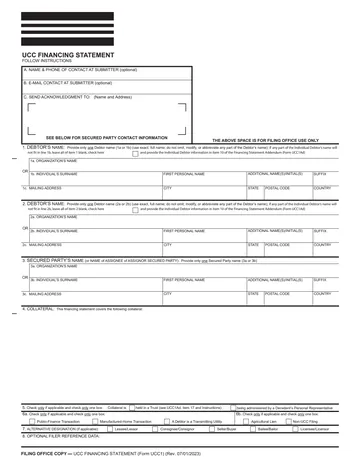
- Who completes it
- The secured party or its filer; the debtor authorizes it, no signature
- Filed with
- The filing office for the debtor's location, with the fee
- Form revision
- Rev. 07/01/2023 (IACA)
- Pages
- Instructions on page 1, the form on page 2
- Effective
- Five years in most states, unless continued
At a glance
Form UCC1 is the UCC Financing Statement in the national set published by the International Association of Commercial Administrators (IACA), the association of state filing officials. The current version prints “(Rev. 07/01/2023)” at its foot. It is two pages: page one is the instructions, page two is the form. Download it from IACA's UCC Forms and Resources page (the 2023 UCC1 PDF).
A financing statement needs very little to work. In the uniform text, “a financing statement is sufficient only if it: (1) provides the name of the debtor; (2) provides the name of the secured party or a representative of the secured party; and (3) indicates the collateral covered by the financing statement.” (Del. Code tit. 6, 9-502(a)). Those are items 1, 3 and 4. Everything else on the form either helps the office index and refuse records correctly (the addresses, the organization or individual split) or changes how the filing behaves (items 5 to 7).
- Who completes it. The secured party, or a filer working for it. The debtor does not sign: “By signing or becoming bound as debtor by a security agreement, a debtor or new debtor authorizes the filing of an initial financing statement” (Del. Code tit. 6, 9-509(b)). Missouri's forms page says it plainly: “Signature lines are not included because they are not required.”
- When. Any time, even first: “A financing statement may be filed before a security agreement is made or a security interest otherwise attaches.” (Del. Code tit. 6, 9-502(d)).
- Where it goes. “Send completed form and any attachments to the filing office, with the required fee.” The office is the one for the debtor's location, usually the Secretary of State of the state where a registered organization was formed; see where to file a UCC-1 and the state pages.
- Paper or online. “Form instructions are intended for paper forms. Electronic UCC filing parameters and instructions may differ from the below instructions.” 11 jurisdictions no longer take paper UCC-1s from the public (Colorado, Delaware, Michigan, Montana, New Jersey, New Mexico, North Dakota, Ohio, Texas, Virginia and West Virginia), so there the form is a worksheet for the online system. The instructions warn that a form with handwritten entries may be rejected.
- What the office does with it. It files and indexes what it receives: “Data are entered into the UCC information management system exactly as provided in a UCC record, without regard to apparent errors.” (MARS 401). An error on the form stays on the record.
Tap a box once for its note, again to jump to the line. Zoom in to read the small print.
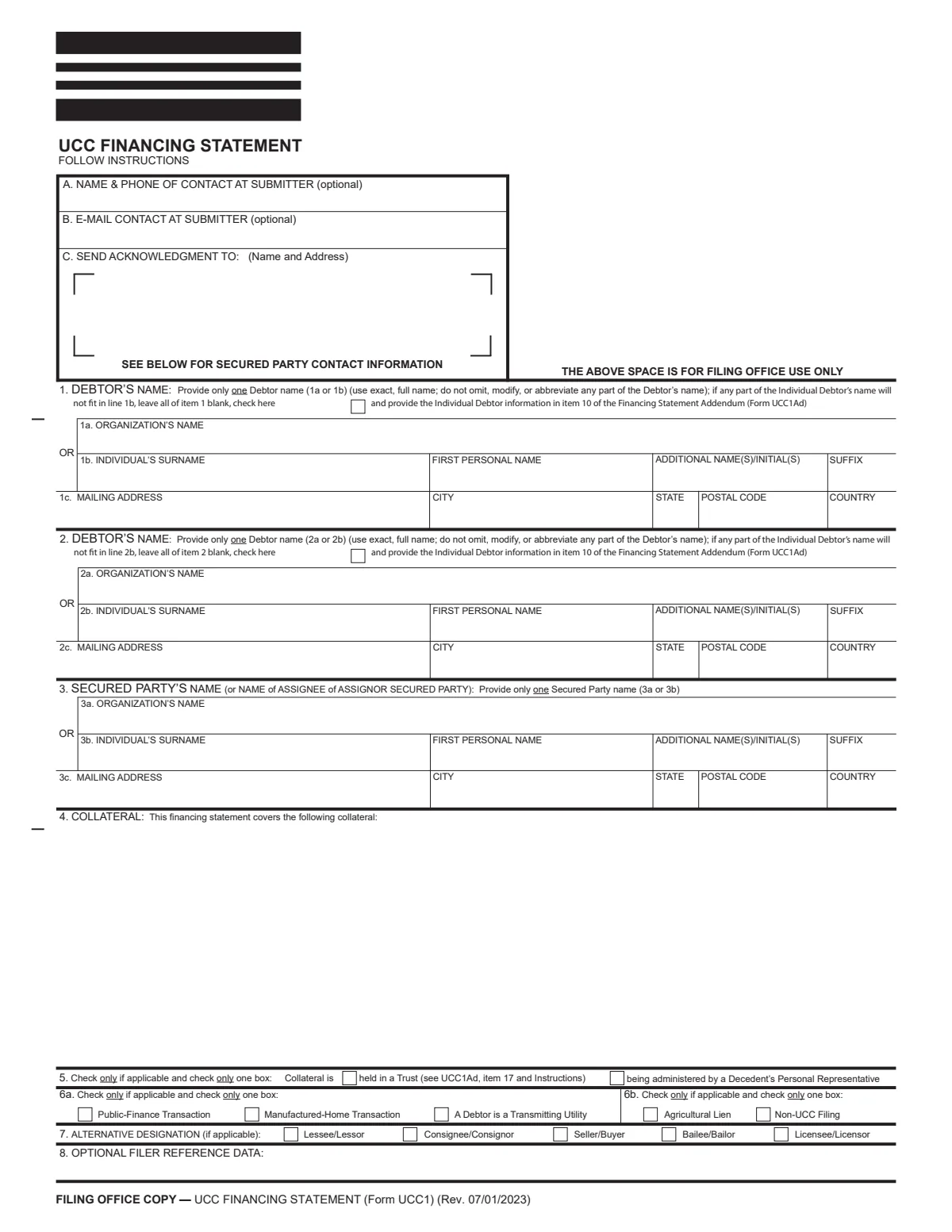
Boxes A to C: the submitter
The three lettered boxes at the top are for the business sending the form, which may be the lender, its law firm or a filing agent. None of them is a party to the financing statement. The large space to the right is for filing office use only: leave it blank.
| Line | Label | What goes there |
|---|---|---|
| A | NAME & PHONE OF CONTACT AT SUBMITTER (optional) | A person at the business submitting the form, so the filing office can ask a question. The instructions make boxes A and B optional. The 2023 revision renamed the box from filer to submitter (IACA revision guide). Nothing here is indexed or searchable as a party. |
| B | E-MAIL CONTACT AT SUBMITTER (optional) | An e-mail address for the same purpose. Optional, and not part of the public record of the parties. |
| C | SEND ACKNOWLEDGMENT TO: (Name and Address) | Complete it if you want the office to send an acknowledgment. For a paper filing with a request for an acknowledgment, “the filing office shall send to the person an image of the record showing the number assigned to the record” and the date and time of filing (Del. Code tit. 6, 9-523(a)). That number is the file number every later UCC-3 must quote in its item 1a. The 2023 form prints “SEE BELOW FOR SECURED PARTY CONTACT INFORMATION” under box C: the person who wants to reach the lender is sent to item 3, not to the submitter. |
Items 1 and 2: the debtor
The debtor's name is the item that most often decides whether a filing works. Searchers find a filing by searching the debtor's correct name, so the form asks for the name exactly, split into organization or individual fields. In the uniform text (here in Minnesota's wording), “a financing statement that fails sufficiently to provide the name of the debtor in accordance with section 336.9-503(a) is seriously misleading” (Minn. Stat. 336.9-506(b)), unless a search under the correct name with the office's standard search logic would still find it.
Form UCC1 instructions 1, 1a and 1b; Del. Code tit. 6, 9-503(c); MARS 304 and 305.
| Line | Label | What goes there |
|---|---|---|
| 1 | 1. DEBTOR'S NAME: Provide only one Debtor name (1a or 1b) | The header sets the two rules for every name box on the form: one name per item, and “use exact, full name; do not omit, modify, or abbreviate any part of the Debtor's name”. The check box is for an individual whose name will not fit in line 1b: leave all of item 1 blank, check the box and give the name in item 10 of the addendum (Form UCC1Ad). IACA's model rules tell filing offices not to refuse that filing: the office shall not refuse a paper UCC-1 that lacks debtor information in item 1 “if the record includes an addendum that provides debtor information in item 10” (MARS 302.3). |
| 1a | 1a. ORGANIZATION'S NAME | For an entity. For a registered organization (a corporation, LLC, limited partnership and the like), the instructions advise checking the debtor's current filed public organic records for its correct name. “Trade name is insufficient.” “If a corporate ending (e.g., corporation, limited partnership, limited liability company) is part of the Debtor's name, it must be included.” The statute says the same about trade names: “A financing statement that provides only the debtor's trade name does not sufficiently provide the name of the debtor.” (Del. Code tit. 6, 9-503(c)). A name that fails the rule is seriously misleading unless a search under the correct name with the office's standard search logic would still find it (Minn. Stat. 336.9-506). To confirm the exact registered name and the entity's status, use the state's business entity search: see how to check a company's good standing on goodstandingrules.com. |
| 1b | 1b. INDIVIDUAL'S SURNAME / FIRST PERSONAL NAME / ADDITIONAL NAME(S)/INITIAL(S) / SUFFIX | For a natural person, including a sole proprietor: the instructions count the name of an individual doing business as a sole proprietorship as an individual name, “whether or not operating under a trade name”. Prefixes and titles such as Mr. or M.D. are generally not part of the name; lineage such as Jr. or III may go in the Suffix box. A one-word name goes in the surname box, with the other boxes left blank. (IACA's rule agrees: a single name “is treated as a surname and shall be entered in the individual surname field”, MARS 302.1.) Which name counts is a state rule: 44 states and DC use Alternative A (the name on the unexpired driver's license or state ID) and 6 use Alternative B (any of three names, the license name among them). See UCC debtor name rules. Where the license shows a suffix, IACA suggests “the filer should consider also providing the name as a separate individual debtor with the suffix included in the Surname field” (MARS 302.2). |
| 1c | 1c. MAILING ADDRESS / CITY / STATE / POSTAL CODE / COUNTRY | The debtor's mailing address. An initial financing statement that does not “provide a mailing address for the debtor” is a refusal ground (Del. Code tit. 6, 9-516(b)(5)). IACA's model rule counts an address as one “as long as it includes at least a city and a state or foreign country” (MARS 100.1); some offices adopt a stricter postal-address version. Do not add identifiers: the instructions bar social security numbers, driver's license numbers, financial account numbers and other non-public personal identifiers anywhere on the form unless state law requires them. |
| 2 | 2. DEBTOR'S NAME: Provide only one Debtor name (2a or 2b) | A second debtor, if there is one, formatted under the same instruction as item 1 (and the same fit-in-the-box check). For a third debtor and more, attach the addendum (UCC1Ad, item 10) or the additional party form (UCC1AP). Trade names and name variations may be added here as extra debtors, but the instructions add: “filer may add such other names as additional Debtors if desired (but this is neither required nor recommended)”. |
| 2a | 2a. ORGANIZATION'S NAME | As 1a: the second debtor's exact registered name, with its corporate ending. |
| 2b | 2b. INDIVIDUAL'S SURNAME / FIRST PERSONAL NAME / ADDITIONAL NAME(S)/INITIAL(S) / SUFFIX | As 1b: the second debtor's name, each part in its own box. |
| 2c | 2c. MAILING ADDRESS / CITY / STATE / POSTAL CODE / COUNTRY | As 1c. Each debtor name on the form needs its own mailing address and an indication of whether it is an individual or an organization (Del. Code tit. 6, 9-516(b)(5)); the 1a or 1b choice is that indication. |
Item 3: the secured party
Item 3 names the secured party of record: the person entitled to amend, continue, assign or terminate the filing. Only one name fits in item 3; a lender group usually names its agent. The address in 3c is public, and it is the only contact for the lender that a searcher or the debtor sees on the record.
| Line | Label | What goes there |
|---|---|---|
| 3 | 3. SECURED PARTY'S NAME (or NAME of ASSIGNEE of ASSIGNOR SECURED PARTY) | “Enter name and mailing address for Secured Party or full Assignee who will be the Secured Party of record.” A financing statement may name an assignee from the start: Delaware's text lets an initial financing statement reflect a full assignment “by providing the name and mailing address of the assignee as the name and address of the secured party” (Del. Code tit. 6, 9-514(a)). The assignor's name may then go in item 11 of the addendum. More secured parties go on the addendum or UCC1AP. |
| 3a | 3a. ORGANIZATION'S NAME | The lender, lessor, seller or other secured party. The statute asks only for “the name of the secured party or a representative of the secured party”, so a representative, such as an agent for a group of lenders, may be named. |
| 3b | 3b. INDIVIDUAL'S SURNAME / FIRST PERSONAL NAME / ADDITIONAL NAME(S)/INITIAL(S) / SUFFIX | A secured party who is a natural person. |
| 3c | 3c. MAILING ADDRESS / CITY / STATE / POSTAL CODE / COUNTRY | Required. An office refuses an initial financing statement that “does not provide a name and mailing address for the secured party of record” (Del. Code tit. 6, 9-516(b)(4)). It is also the address a debtor uses to send the signed demand for a termination; see how to remove a UCC lien. |
Item 4: collateral
Item 4 is a single large box. What goes in it is a legal choice for the secured party, usually matching or summarizing the security agreement. The detailed rules (all assets indications, after-acquired property, proceeds) are on the collateral description page and the UCC-1 financing statement guide.
| Line | Label | What goes there |
|---|---|---|
| 4 | 4. COLLATERAL: This financing statement covers the following collateral: | The third required element. The financing statement can be broad even when the security agreement is not: it “sufficiently indicates the collateral that it covers” with “an indication that the financing statement covers all assets or all personal property” (Del. Code tit. 6, 9-504), or with a description of the collateral. If the box is too small, continue the description in item 12 of the addendum (Form UCC1Ad) or on an exhibit incorporated by reference. Timber to be cut, as-extracted collateral and fixture filings need the addendum's real estate items 13 to 16, and the state's law decides where those filings go. Delaware adds a county shortcut: for a filing in the real property records, the county tax assessment parcel number placed in item 4 can satisfy its recording rule (Del. Code tit. 6, 9-516(c)(3)). |
Items 5 to 8: check boxes and reference
Most UCC-1s leave items 5 to 7 blank. Each box that is checked changes how the office indexes the filing or how long it lasts, and items 5 and 6a can only be checked on the initial financing statement: a later UCC-3 cannot add them.
| Line | Label | What goes there |
|---|---|---|
| 5 | 5. Collateral is held in a Trust / being administered by a Decedent's Personal Representative | Check only if it applies, and only one box. For a trust, the debtor name is the trust's name (or its settlor's), and the form points to the addendum's item 17 for trust information. For an estate, the debtor name is the decedent's, entered in 1b. “The indication that the collateral is being held in a trust may only be made on the initial financing statement.” (MARS 305; MARS 304 says the same for a personal representative.) If several debtors are named and the box does not fit all of them, the instructions suggest a separate UCC1 for each debtor. |
| 6a | 6a. Public-Finance Transaction / Manufactured-Home Transaction / A Debtor is a Transmitting Utility | Changes the life of the filing. In the uniform text, an initial financing statement “is effective for a period of 30 years after the date of filing if it indicates that it is filed in connection with a public-finance transaction or manufactured-home transaction” (Del. Code tit. 6, 9-515(b)), and for a transmitting utility: “If a debtor is a transmitting utility and a filed initial financing statement so indicates, the financing statement is effective until a termination statement is filed.” (Del. Code tit. 6, 9-515(f)). If both a transaction box and the utility box apply, the instructions say “check only that a Debtor is a Transmitting Utility”. “The only means to indicate that an initial financing statement is filed in connection with a manufactured-home or public-finance transaction, or that the debtor is a transmitting utility, is on the initial financing statement.” (MARS 100.8). Several states changed the 30-year rule; see the table below. |
| 6b | 6b. Agricultural Lien / Non-UCC Filing | For an agricultural lien, or for a lien that is not a UCC security interest but is filed in the UCC records (a tax lien or judgment lien, for example); attach what the other law requires. An ordinary loan or lease filing leaves 6b blank. |
| 7 | 7. ALTERNATIVE DESIGNATION (if applicable): Lessee/Lessor, Consignee/Consignor, Seller/Buyer, Bailee/Bailor, Licensee/Licensor | Optional labels for deals that may or may not be secured transactions: a true lease, a consignment, a sale of accounts or payment intangibles. The statute allows them and says the filing “is not of itself a factor in determining whether the collateral secures an obligation” (Del. Code tit. 6, 9-505). |
| 8 | 8. OPTIONAL FILER REFERENCE DATA | Optional, and for the filer's own use. An internal deal or file reference helps match the acknowledgment to the loan. Keep financial account numbers out: the instructions bar them anywhere on the form. |
Box 6a's 30-year period is the uniform rule, but the state rows list these departures (every other state follows the uniform five years, 30 years for the two transactions, and no lapse for a transmitting utility, or its texts do not say otherwise):
| State | What the state's law does with the 30-year period |
|---|---|
| Alaska | 30 years for manufactured-home filings only (no public-finance period) |
| Colorado | No 30-year public-finance period (30 years for manufactured-home transactions only); Colorado adds records under C.R.S. 4-9-528 to the five-year rule |
| Florida | No 30-year public-finance period (30 years for manufactured-home transactions only) |
| Georgia | Five years, or until the 20th day after any earlier maturity date required to be specified on the financing statement (O.C.G.A. 11-9-515(a)); a continuation may be filed within six months before either date. Georgia's 11-9-515 has no 30-year public-finance or manufactured-home period and no transmitting utility rule (its subsections run (a) to (e)); a continuation for consumer goods securing $5,000 or less may carry the obligation's earlier maturity date (11-9-515(d)) |
| Kansas | The 30-year period applies to manufactured-home transactions only (no public-finance 30-year rule) |
| Louisiana | 30-year period for public-finance transactions only (no manufactured-home rule); vehicle (OMV) and vessel (Wildlife and Fisheries) filings last until terminated; continuations go to the parish of the original filing |
| Michigan | No 30-year public-finance term (manufactured homes only); statements filed before March 29, 2009 by an individual claiming to be a transmitting utility last 5 years and cannot be continued |
| Missouri | No 30-year public-finance term (manufactured homes only) |
| North Dakota | No 30-year period for public-finance or manufactured-home filings; all filings 5 years except transmitting utilities |
| Oregon | 30-year term for public-finance transactions only (no manufactured-home term); on request the Secretary of State sends a secured party a renewal notice report of its filings that expire between 90 days and one year after the notice (ORS 79A.5150) |
| South Dakota | 30-year term covers manufactured-home transactions only (no public-finance term); statements filed before July 1, 1997 were effective five years plus 60 days |
| Tennessee | 30 years for an initial financing statement that indicates it is filed in connection with a public-finance or manufactured-home transaction (Tenn. Code Ann. 47-9-515(b)) |
| Washington | No 30-year public-finance or manufactured-home period: RCW 62A.9A-515(b) is reserved |
| West Virginia | 40 years for manufactured-home and public-finance filings that say so (W. Va. Code 46-9-515(b); the uniform text says 30) |
Lapse and continuation dates for any state are on the UCC continuation page and in the lapse date calculator.
A filled-in example
A lender finances equipment for an Illinois LLC. The owner also pledges equipment she owns personally through her sole proprietorship, so she is a second debtor. The names and addresses below are made up. Boxes A and B are left blank.
| Item | Example entry | Why |
|---|---|---|
| C | Example Equipment Finance Co., Lien Desk, 400 Sample Avenue, Springfield, IL 62701 | Where the acknowledgment copy goes |
| 1a | EXAMPLE FABRICATION LLC | The exact name on the LLC's articles of organization, ending included |
| 1c | 123 Example Road | Springfield | IL | 62701 | USA | Every debtor needs a mailing address |
| 2b | DOE | JANE | A | | A sole proprietor co-debtor: her own name, not her shop's trade name |
| 2c | 45 Sample Lane | Springfield | IL | 62702 | USA | Her mailing address |
| 3a | EXAMPLE EQUIPMENT FINANCE CO. | The secured party of record |
| 3c | 400 Sample Avenue | Springfield | IL | 62701 | USA | Required; searchers and the debtor use it |
| 4 | All equipment, now owned or later acquired, and its proceeds | A description of the collateral; "All assets" would also be a sufficient indication |
| 5 to 7 | Blank | No trust, estate, public-finance, manufactured-home, utility, farm or non-UCC lien; not a lease |
| 8 | Deal EX-2026-014 | An internal reference, not an account number |
Two things in the example are the common failure points. Item 1a copies the LLC's registered name, ending included, from the state's business records rather than from an invoice or a website. Item 2b is the owner's own name in Illinois's form (Alternative A: the name on her unexpired Illinois driver's license), not the name on her shop sign.
State rules that change a box
The national form is built for the uniform text. A filing office that accepts paper “may not refuse to accept a written initial financing statement in the following form and format except for a reason set forth in” the refusal grounds (Del. Code tit. 6, 9-521(a)), but several states add requirements the form has no box for. IACA's answer is the addendum: its item 17 exists because “some states have non-uniform requirements” (Form UCC1Ad, instruction 17).
- New York: organization debtors. The Department of State says “the National Standard UCC forms are not acceptable for filing in New York State when the debtor is an organization”. New York's version of the refusal grounds still requires, for an organization debtor, “a type of organization for the debtor” and “a jurisdiction of organization for the debtor” (N.Y. U.C.C. 9-516(b)(5)(C)). Use New York's own form; see the New York page.
- Florida: the documentary stamp tax notation. “The clerk or filing officer shall not accept for filing or filing and recording any financing statement under chapter 679, unless there appears thereon a notation that the taxes required by this chapter have been paid” (Fla. Stat. 201.22). The national form has no box for it, and Florida's texts do not name one; it must appear on the financing statement. Florida also refuses an individual debtor without “the individual’s last name and first name” (Fla. Stat. 679.516(2)(c)1.). The registry “will accept forms dated 2011 or later, as approved forms until further notice.” See the Florida page.
- Louisiana: a penalty for older forms. “A non-standard form penalty will be accessed to any National UCC forms with revision dates prior to July, 2023”. See the Louisiana page.
- Georgia: 2011 or later. “If a filing is submitted on an IACA UCC form with a revision date prior to April 20, 2011, filing offices will reject the filing as not communicated by a method of communication authorized by the filing office.” (GSCCCA Rule 103.)
- California: the current national forms only. The forms page warns: “All other forms are obsolete and will be rejected by the filing office.”
- Individual names everywhere. Line 1b is the same box in every state, but the name that belongs in it follows the state's Alternative A or B. The state pages and the debtor name rules table say which.
Mistakes the form invites
- A trade name in 1a. The form, the instructions and the statute all reject it. Add the trade name as a second debtor only if you want to; it never replaces the legal name.
- A sole proprietor's business name in 1a. A sole proprietorship is an individual for the form: the owner's name goes in 1b.
- Two names in one item. One debtor per item, one secured party in item 3. Variations go in their own items with their own addresses.
- Abbreviating. Do not abbreviate a word the debtor's name does not already abbreviate.
- Checking 6a later. The 30-year and transmitting utility indications work only on the initial financing statement.
- Personal identifiers. Social security numbers, license numbers and account numbers do not belong anywhere on the form, item 8 included.
- Losing the acknowledgment. The file number on it is what every continuation, amendment and termination must quote.
How it connects
The rules behind the boxes are on the guides: what a UCC-1 must contain, where to file, debtor name rules and lapse and continuation. Fees for each state are in the UCC filing fees by state table and the fee finder. After filing, every change goes on the UCC3 amendment form; extra debtors, secured parties and real estate details go on the UCC1Ad addendum and the UCC1AP additional party form. All the national forms are on the forms hub.
IACA Form UCC1 and instructions (Rev. 07/01/2023); Del. Code tit. 6, 9-502, 9-516 and 9-523(a); MARS 304, 305 and 100.8.
Common questions
Does the debtor have to sign a UCC-1?
No. The form has no signature line. The debtor authorizes the filing by signing the security agreement, and the secured party or its filer submits the form.
Can I still use the 2011 version of Form UCC1?
It depends on the state. IACA still posts the 2011 forms for offices that take them; Florida takes national forms dated 2011 or later, Louisiana charges a penalty on national forms older than July 2023, and California rejects older forms. Check the state page before filing on paper.
What if the debtor's name does not fit in line 1b?
Leave all of item 1 blank, check the box in item 1, and give the individual's name in item 10 of the addendum (Form UCC1Ad), with the box in its item 9 checked. IACA's model rules tell offices not to refuse that filing.
Should I list the debtor's trade name too?
Only as an extra debtor in its own item, and the instructions say that is neither required nor recommended. The legal name must always be there; a trade name alone does not sufficiently provide the debtor's name.
Is all assets enough in item 4?
On the financing statement, yes: an indication that it covers all assets or all personal property is sufficient. The security agreement is a different document with stricter description rules.
Where do I send Form UCC1?
To the filing office for the debtor's location, with the fee: usually the Secretary of State of the state where a registered organization was formed, or the state of an individual's principal residence. Several states take only online filings.
Sources
- IACA, UCC Financing Statement (Form UCC1) (Rev. 07/01/2023), with its instructions
- IACA, UCC Financing Statement Addendum (Form UCC1Ad) (Rev. 07/01/2023), instruction 17
- IACA, Model Administrative Rules (2024 ed.): rules 100.1, 100.8, 302, 304, 305 and 401
- IACA, UCC Forms and Resources
- Delaware Code, title 6, Article 9, Part 5 (9-502, 9-503, 9-504, 9-505, 9-509, 9-514, 9-515, 9-516, 9-521, 9-523), the uniform wording as Delaware enacted it
- Minnesota Statutes 336.9-506, effect of errors or omissions
- New York Department of State, UCC frequently asked questions; N.Y. U.C.C. 9-516
- Fla. Stat. 201.22; Fla. Stat. 679.516; Florida Secured Transaction Registry, UCC forms
- Louisiana Secretary of State, UCC fees and forms; GSCCCA UCC Administrative Rules; California Secretary of State, UCC forms
- Missouri Secretary of State, UCC forms