- What it is
- Public notice of a possible security interest (a UCC-1 financing statement)
- How long
- Five years from filing unless continued
- Paid off?
- Signed demand: the secured party has 20 days
- Never authorized?
- No legal effect; demand, information statement or the state's procedure
What a UCC lien is
A "UCC lien" is the everyday name for a UCC-1 financing statement: a short public record, filed with a state office, saying that a lender or seller may hold a security interest in some of a debtor's personal property. The law's own name for the record is the financing statement, which Delaware's text defines as “a record or records composed of an initial financing statement and any filed record relating to the initial financing statement” (Del. Code tit. 6, 9-102(a)(39)). Filing offices describe it in plainer words. Tennessee's answer to "What is a UCC-1?" is that it is “filed to provide notice that a creditor has a security interest in a debtor's personal property. It is not an agreement. It is just notice to the world that one person claims an interest in someone else's property, usually as collateral for a debt.” (Tennessee Secretary of State, UCC FAQ).
The filing exists because of how secured lending works. A lender that takes collateral wants its claim to rank ahead of later lenders and a bankruptcy trustee, and for most business property it gets there by filing: “a financing statement must be filed to perfect all security interests and agricultural liens”, subject to listed exceptions (UCC 9-310(a), as enacted (Delaware's text)). Michigan's filing office puts the same idea from the searcher's side: “When a debtor pledges collateral on a loan, UCC search results show lenders whether others have filed a claim against the same collateral.” It also names the borrower's side of the bargain: “Debtors also benefit because the notice system helps them obtain business funding.” (Michigan Department of State, UCC pages).
So a filing against your business usually means one thing: at some point you signed a loan, lease, line of credit, equipment financing or supplier agreement that gave the other side a security interest, and it filed to protect its place in line. The filing names you as the debtor and the lender or seller as the secured party. The law gives the filer that right when you sign: “By signing or becoming bound as debtor by a security agreement, a debtor or new debtor authorizes the filing of an initial financing statement” (UCC 9-509(b), as enacted (Delaware's text)).
UCC 9-509(b), 9-519(a) and 9-515(a), as enacted (Delaware's text); IACA Model Administrative Rule 200. The amber step is the one owners miss: the office files what it receives.
What a UCC filing is not
It is not proof that you owe money today. A filing can be made before any loan is closed: “A financing statement may be filed before a security agreement is made or a security interest otherwise attaches.” (UCC 9-502(d), as enacted (Delaware's text)). The IRS warns its own collection staff of the same thing: “Do not assume, however, that a creditor's security interest is perfected just because a financing statement has been filed.” (IRM 5.17.2). A lender that pre-filed for a deal that never closed, or a loan paid off years ago, can leave a filing on the record with nothing behind it.
It is not the security agreement. The contract you signed is what creates the lender's rights in your property. The filing only gives notice of them. Michigan describes the financing statement as a record that “provides public notice of the security agreement between a debtor and the secured party, the lender”.
It is not a ruling by the state. The filing office does not decide whether a debt exists or whether the filing was proper. IACA's Model Administrative Rules, written for filing offices, say the office “does not determine the legal sufficiency of the record” and does not determine “that the record's information is correct” (IACA Model Administrative Rule 200). That is why a filing can sit on your record after the loan is gone, and why the law gives you tools to clear it (below).
It is not a tax lien or a court judgment. Those are separate records with their own rules, even when a state's UCC search shows them in the same results. See UCC liens and tax liens.
What it covers: blanket liens
Every financing statement must indicate the collateral it covers, and the law lets that indication be very broad. A filing is sufficient if it gives “a description of the collateral pursuant to Section 9-108” or “an indication that the financing statement covers all assets or all personal property” (UCC 9-504, as enacted (Delaware's text)). A filing that says "all assets" is what lenders and owners call a blanket lien, and it is lawful on the filing.
The security agreement is held to a stricter rule. In the contract itself, “A description of collateral as ‘all the debtor’s assets’ or ‘all the debtor’s personal property’ or using words of similar import does not reasonably identify the collateral.” (UCC 9-108(c), as enacted (Delaware's text)). So the filing can say "all assets" while the agreement lists categories such as equipment, inventory, accounts and general intangibles. If you want to know what a lender can actually reach, read the security agreement, not just the filing.
Why it matters to you: a blanket filing tells every later lender and buyer who searches your name that an earlier creditor may claim everything you own. A filing left on the record after a loan is paid still sends that message until it is terminated or lapses, which is why it is worth clearing.
How long it stays
A UCC filing does not last forever. Under the uniform rule, “a filed financing statement is effective for a period of five years after the date of filing” (UCC 9-515(a), as enacted (Delaware's text)). The secured party can keep it going by filing a continuation in the six months before the lapse date; if it does not, “Upon lapse, a financing statement ceases to be effective” (UCC 9-515(c)). A few kinds of filings run longer: 30 years for public-finance and manufactured-home transactions that say so, and no fixed end for a transmitting utility (UCC 9-515(b) and (f)). Wyoming sets ten years, and each state page gives its own rule (see the states).
UCC 9-515(a), 9-513(c) and 9-519(g), as enacted (Delaware's text).
Lapse does not make the record disappear at once. “The filing office may not remove a debtor’s name from the index until one year after the effectiveness of a financing statement naming the debtor lapses” (UCC 9-519(g), as enacted (Delaware's text)). Some offices keep records longer: Colorado's answer to "Why is my UCC lien still showing on your website?" is that “we display records for two years past the lapse date to afford financial institutions the opportunity to retrieve that information for their records.” A terminated filing also stays visible, marked terminated. Arkansas puts it plainly: “Filing a termination does not remove the financing statement from the filing office's records.” (Arkansas Secretary of State, UCC customer manual). What changes is the record's status: a terminated or lapsed filing no longer works as notice of a security interest. The lapse date calculator gives the lapse date from the filing date.
How to find UCC filings on your business
Search the state where the filing should be. For a corporation, LLC or limited partnership that is the state where it was formed, not where it does business; for a person, the state where they live (see where to file a UCC-1). Each state page links the state's own online search by debtor name, and the UCC lien search guide explains how to search and read the results. Search your business's exact registered name and the common variations, and keep the file numbers you find: every next step (a demand, a termination, an information statement) identifies the filing by its file number.
A search result is a summary. To see the collateral and the secured party's address, open the filing image or order copies. Two limits to keep in mind: filings for fixtures, timber and minerals are made in the county real property records, and some states index tax liens separately from UCC filings (see what a UCC search does not show). If a lender or buyer sent you a search report, the file numbers on it are your starting point.
Why the filing office took it
Owners who find a filing they do not recognize often ask why the state accepted it. The answer is that the filing office is a records office, not a judge. Colorado says so directly: “Our office is simply a filing office for public records. We are not able to verify whether a filing is valid or accurate.” Iowa's office calls itself “a filing repository and does not determine the authority of a filer to make a submission.” The office may refuse a record only for the reasons its statute lists, such as a missing debtor name or the wrong fee, and no signature is required on a UCC-1 (Michigan: “No, signatures are not required on initial UCC filings or their amendments.”).
The law handles the risk on the back end instead. A filing the debtor never authorized does not work: “A filed record is effective only to the extent that it was filed by a person that may file it under Section 9-509.” (UCC 9-510(a), as enacted (Delaware's text)). Several states have added their own procedures to clear such filings faster. The wrongful UCC filing page covers both.
What to do about it
UCC 9-513(c) and 9-510(a), as enacted (Delaware's text); the Alabama Secretary of State's warning about mailed UCC forms.
You still owe the debt. The filing is doing what the law intends. It will be terminated when the debt is paid and no commitment to lend remains, or it will lapse if the secured party does not continue it. Nothing on this site's borrower pages changes that.
You paid it off. For business collateral, the secured party's duty to clear the record starts with your request. It must act “within 20 days after a secured party receives a signed demand from a debtor”: file a termination statement or send one to you (UCC 9-513(c), as enacted (Delaware's text)). If it does not, you may file the termination yourself, marked as authorized by the debtor (UCC 9-509(d)(2)). How to remove a UCC lien walks through the demand, and the termination demand letter is a template for it. For consumer goods the secured party has to terminate within one month of payoff even without a demand (UCC 9-513(b)(1)). See also a UCC lien after the loan is paid off.
You never authorized it. The same 20-day demand applies to a filing “the debtor did not authorize” (UCC 9-513(c)(4)), and you can put your side on the record with an information statement under UCC 9-518. 11 states give a debtor an affidavit procedure that leads the office to terminate the filing, and others review claims or let a court clear the record. See wrongful or fraudulent UCC filings.
You got a bill or a form in the mail. Read it closely before paying. Alabama's Secretary of State warns: “The Secretary of State's Office has received complaints regarding fraudulent Uniform Commercial Code (UCC) forms being mailed out to businesses. The Alabama Secretary of State's Office does not mail UCC forms out to businesses. Businesses pay the filing fee at the time of submission. The Secretary of State will never mail an invoice to you.” (Alabama Secretary of State, UCC home page). Pay a filing fee only to the state's own filing system. More in UCC filing scams.
UCC liens and tax liens
A notice of federal tax lien is not a UCC filing, though many states file it in the same office and some show it in the same search. Federal law lets each state choose the office: for personal property, “in one office within the State (or the county, or other governmental subdivision), as designated by the laws of such State” (IRC 6323(f)(1)(A))IRC 6323Internal Revenue Code, Cornell LII. Michigan's UCC FAQ, for example, tells readers who to call “about an Internal Revenue Service federal tax lien on my UCC search results”. A UCC termination does nothing to a tax lien: the IRS releases or withdraws its own notices. See federal tax lien search for where each state files them, and taxproc.com's guide to federal tax liens for the IRS release, withdrawal and discharge process.
Forms, line by line
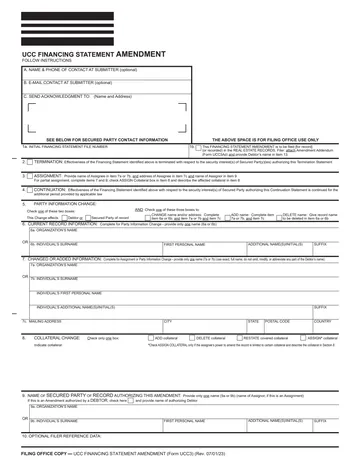
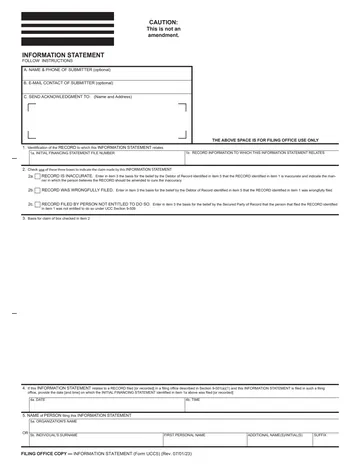
Templates
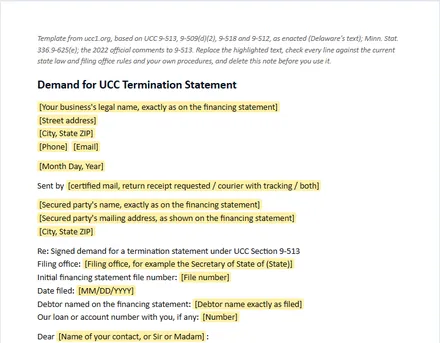
Termination demand letter
The debtor's signed demand under UCC 9-513 for a paid or unauthorized filing: the file number, the ground, the 20 days. Word download.
Common questions
What does a UCC lien mean for my business?
It means a lender, lessor or seller filed public notice that it may hold a security interest in some or all of your business property, usually under a loan or lease you signed. The filing itself does not prove a debt is owed today; it can be filed before a loan closes (UCC 9-502(d)) and can outlive a paid-off loan until it is terminated or lapses.
Does a UCC lien hurt my credit?
The filing is a public record that lenders, landlords and buyers see when they search your business's name, and a blanket filing tells a new lender that an earlier one may claim everything. That is why an old filing for a paid-off loan should be terminated: ask the secured party with a signed demand.
How long does a UCC lien stay on file?
Five years from the filing date unless the secured party files a continuation in the last six months (UCC 9-515(a) and (d)); Wyoming sets ten years. The record stays in the index for at least a year after the filing lapses, or after it would have lapsed if it was terminated (UCC 9-519(g)); some offices keep records longer.
Can I remove a UCC lien myself?
Only in the cases the law allows. If the loan is paid or you never authorized the filing, send the secured party a signed demand; if it does not file or send a termination within 20 days, you may file a termination yourself, marked as authorized by the debtor (UCC 9-513(c) and 9-509(d)(2)).
Why did the state accept a UCC filing I never agreed to?
Filing offices are ministerial: they accept a record that meets the statute's requirements and do not decide whether the filer had the right to file. An unauthorized filing has no legal effect (UCC 9-510(a)), and several states have an affidavit or review procedure to clear it.
Sources
- UCC Article 9 as enacted in Delaware (the model text): Del. Code tit. 6, 9-102 and 9-108, 9-310, 9-502, 9-504, 9-509, 9-510, 9-513, 9-515, 9-518 and 9-519
- IACA Model Administrative Rules (2024), Rule 200
- Filing office pages: Tennessee Secretary of State, UCC FAQ; Michigan Department of State, UCC FAQ and UCC page; Colorado Secretary of State, termination FAQ and spurious liens FAQ; Iowa Secretary of State, UCC page; Arkansas Secretary of State, UCC customer manual (2026); Alabama Secretary of State, UCC home page
- 26 U.S.C. 6323 (place for filing a notice of federal tax lien); IRM 5.17.2 (federal tax liens and UCC filings)