- Perfects
- Most security interests in personal property (UCC 9-310(a))
- Must give
- Debtor, secured party, collateral (UCC 9-502(a))
- Lasts
- Five years; ten in Wyoming (UCC 9-515(a))
- Filed in
- The debtor's state (UCC 9-301(1), 9-307)
What a UCC filing does
A UCC filing is a public notice. A lender, lessor or seller that takes a security interest in a business's personal property (its equipment, inventory, receivables and the like) files a short record, the financing statement, with a state filing office. The filing does not create the loan or the lien. It tells anyone who searches the debtor's name that a creditor may claim an interest in the property described, and it is what the law calls perfection for most collateral. The uniform rule, as Delaware enacted it: “a financing statement must be filed to perfect all security interests and agricultural liens” (UCC 9-310(a), Delaware's text).
The term "financing statement" covers more than the first filing. It “means a record or records composed of an initial financing statement and any filed record relating to the initial financing statement” (UCC 9-102(a)(39), Delaware's text). The first record is the UCC-1 (the initial financing statement); every later change, continuation, assignment or termination is a UCC-3 amendment linked to it by file number.
Why perfection matters: when two creditors claim the same collateral, the order usually follows the public record. Under the general rule, “Conflicting perfected security interests and agricultural liens rank according to priority in time of filing or perfection.” (UCC 9-322(a)(1), Delaware's text). A creditor that never files (or files in the wrong place or under the wrong name) can lose to a later creditor that filed correctly, and to a bankruptcy trustee. That is why most of this section is about getting three details right: the state, the debtor's exact name and the timing.
Filing is the default, not the only method. Some interests are perfected when they attach, for example “a purchase-money security interest in consumer goods” (UCC 9-309(1), Delaware's text), and a financing statement does nothing for property under a certificate of title or a federal registry: “the filing of a financing statement is not necessary or effective to perfect a security interest in property subject to” those statutes (UCC 9-311(a), Delaware's text). A car loan is noted on the title, not filed with the Secretary of State.
UCC 9-509(b), 9-301(1), 9-307, 9-506 and 9-520(a), Delaware's and Minnesota's texts. The amber step is the one most filings get wrong.
Filing before the loan closes
A secured party may file before the deal is signed. The uniform text says so plainly: “A financing statement may be filed before a security agreement is made or a security interest otherwise attaches.” (UCC 9-502(d), Delaware's text). Priority then dates from the filing, and the interest is perfected the moment it attaches: “A security interest is perfected when it attaches if the applicable requirements are satisfied before the security interest attaches.” (UCC 9-308(a), Delaware's text). That is why a secured party can file at the commitment stage, before the closing.
The flip side is that a filing on the record is not proof of a debt. The IRS tells its own lien staff the same thing: “Do not assume, however, that a creditor's security interest is perfected just because a financing statement has been filed.” (IRM 5.17.2). A business that finds a UCC filing against itself should read it in that light: it shows that someone filed, not that anything is owed today. The borrower pages explain what a UCC lien means and how to get one removed.
The debtor's consent still matters. A filing needs the debtor's authorization, and the security agreement supplies it: “By signing or becoming bound as debtor by a security agreement, a debtor or new debtor authorizes the filing of an initial financing statement” (UCC 9-509(b), Delaware's text). A record filed without that authority has no effect: “A filed record is effective only to the extent that it was filed by a person that may file it under Section 9-509.” (UCC 9-510(a), Delaware's text).
What a financing statement must say
The financing statement is short by design. Under the uniform text it “is sufficient only if it: (1) provides the name of the debtor; (2) provides the name of the secured party or a representative of the secured party; and (3) indicates the collateral covered by the financing statement.” (UCC 9-502(a), Delaware's text) No signature, no loan amount and no copy of the security agreement. The collateral can be described broadly: the filing may give “an indication that the financing statement covers all assets or all personal property” (UCC 9-504(2), Delaware's text). Filings in the real property records (fixtures, timber to be cut, as-extracted collateral) add a real estate description and, where the debtor is not the owner of record, the record owner's name (UCC 9-502(b), Delaware's text).
Of the three items, the debtor's name causes the most trouble, because searches run on names. A filing with a name the state's search would not find is generally ineffective. The UCC-1 guide covers each item and the national form; the debtor name rules page covers names in depth.
What the filing office does and does not do
The filing office is a recorder, not a reviewer. Filing offices write their rules with IACA's Model Administrative Rules in view (Delaware's statute, for one, tells its office to “consult the most recent version of the Model Rules” (UCC 9-526(b)(2), Delaware's text)), and the model rules put it this way: “the duties and responsibilities of the filing office with respect to the administration of the UCC are ministerial”, and “the filing office does not determine the legal sufficiency of the record” (IACA Model Administrative Rules 200). The statute limits refusals to a closed list: “A filing office shall refuse to accept a record for filing for a reason set forth in Section 9-516(b) and may not refuse to accept a record for filing for any other reason.” (UCC 9-520(a), Delaware's text). The list covers mechanical problems (no fee, no debtor name, no mailing address, a late continuation), not legal ones.
Two results follow. A record that is accepted may still be ineffective (a wrong name, the wrong state). And a record that is wrongly refused may still count: it “is effective as a filed record except as against a purchaser of the collateral which gives value in reasonable reliance upon the absence of the record from the files” (UCC 9-516(d), Delaware's text). The rules leave responsibility with the filer: “The responsibility for the legal effectiveness of filing rests with filers and Remitters and the filing office bears no responsibility for such effectiveness.” (IACA Model Administrative Rules 205). See UCC filing rejections.
The life of a filing
A financing statement does not last forever. The uniform rule: “a filed financing statement is effective for a period of five years after the date of filing” (UCC 9-515(a), Delaware's text). To keep it alive the secured party files a continuation in the last six months; to end it early, a termination. Between those points it may be amended (new collateral, a new debtor name, a new address) or assigned to a new secured party, each by a UCC-3.
UCC 9-515(a), (c) and (d) and 9-519(g), Delaware's text. Wyoming's period is ten years for filings since July 1, 2013.
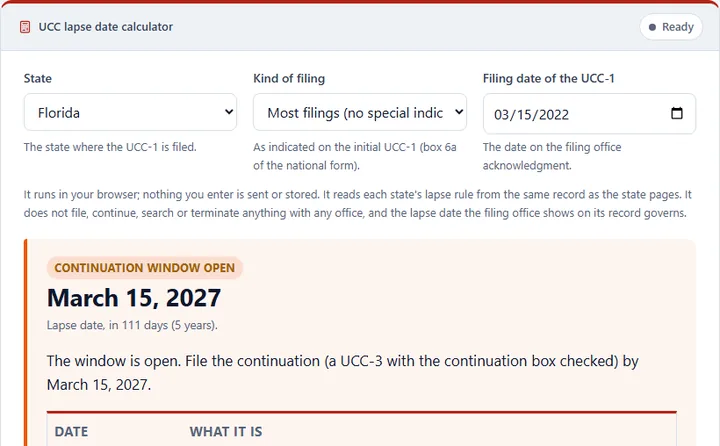
Lapse is not a formality. When a filing lapses, the security interest “becomes unperfected, unless the security interest is perfected otherwise”, and it is treated as never perfected against a buyer of the collateral for value (UCC 9-515(c), Delaware's text). The continuation guide and the lapse date calculator cover the date math. For changes, see the UCC-3 guide; for ending a filing, UCC termination.
How the states differ
Every state and DC enacted the same Article 9 framework, so the rules on this page apply everywhere. The differences are in the details each legislature chose: who the filing office is, the fees, whether paper is still taken, the individual name rule and, in a few states, the filing period.
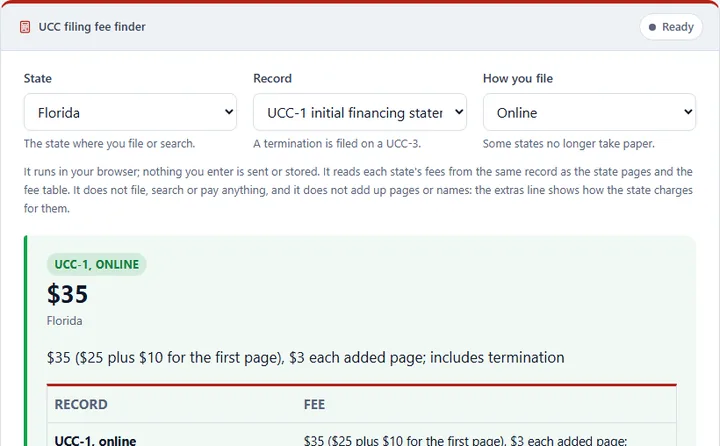
Counted from each state's enacted Article 9 and filing office pages, as shown on the state pages.
The filing office is usually the Secretary of State, but not in 13 jurisdictions: Alaska, District of Columbia, Florida, Georgia, Hawaii, Louisiana, Maryland, New Jersey, Oklahoma, Utah, Virginia, Washington, Wisconsin. Most states still take paper, but 11 file online only as a rule: Colorado, Delaware, Michigan, Montana, New Jersey, New Mexico, North Dakota, Ohio, Texas, Virginia, West Virginia. For individual debtors, 45 jurisdictions require the driver's license name (Alternative A) and 6 accept any of three names (Alternative B: Alaska, Colorado, Connecticut, Delaware, New Hampshire, Wyoming). Each state page quotes its own statute and office pages, and UCC filing fees by state sets out the fees side by side.
The filing guides
The guides in this section, in the order a filer meets them:
| Guide | What it answers |
|---|---|
| UCC-1 financing statement | The three things a UCC-1 must give, what it does not need, and the national UCC1 form box by box |
| Where to file a UCC-1 | Which state (the debtor's location) and which office inside it (central office or county records) |
| Debtor name rules | Registered organizations, Alternative A and B for individuals, seriously misleading names and search logic |
| Collateral descriptions | All assets on the filing versus a specific description in the security agreement |
| Continuation and lapse | Five years, the six-month window, date math, and the states that differ |
| UCC-3 amendments and assignments | Changing parties or collateral, assigning a filing, and who must authorize each change |
| UCC termination | When the secured party must terminate, the 20-day demand and the debtor-authorized termination |
| Purchase money security interests | The priority rules for sellers and lenders who finance the purchase of the collateral |
| Fixture filings | Filings in the real property records for goods that become fixtures |
| Filing rejections | The closed list of grounds on which an office must refuse a record |
| The 2022 amendments | Each state's enactment and what changed for filers |
| Farm products central filing | The Food Security Act's effective financing statements in central filing states |
Forms, line by line
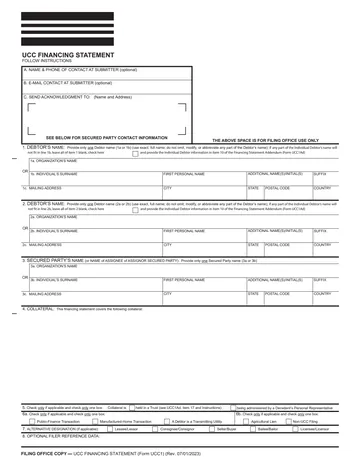
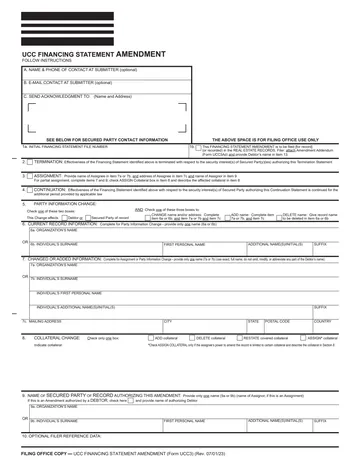
Tools for this topic
Templates
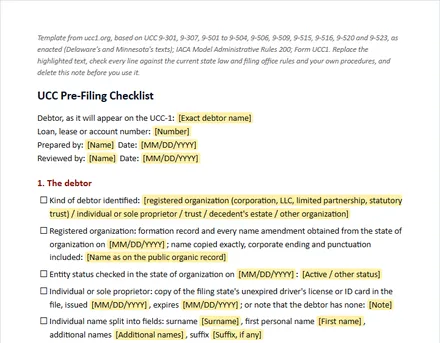
Pre-filing checklist
Check a UCC-1 before it goes in: the debtor's exact name and state, the office, the signed security agreement, collateral, the search first, the form and fee. Word download.
Common questions
What is a UCC filing?
A financing statement filed with a state filing office to give public notice that a creditor claims a security interest in a debtor's personal property. Filing is how most security interests are perfected (UCC 9-310(a)).
Who files the UCC-1, the lender or the borrower?
The secured party (the lender, lessor or seller) or someone it hires. The debtor does not sign the UCC-1, but the filing must be authorized by the debtor, and signing the security agreement does that (UCC 9-509(b)).
Does the filing office check that a UCC-1 is correct?
No. The office's duties are ministerial; it may refuse a record only for the reasons in UCC 9-516(b), such as a missing fee, debtor name or mailing address. A filing can be accepted and still be ineffective, for example under the wrong debtor name.
How long does a UCC filing last?
Five years from the date of filing in every state but Wyoming, where filings made since July 1, 2013 last ten years. A continuation filed in the last six months adds another period; without it the filing lapses.
Can a UCC-1 be filed before the loan closes?
Yes. A financing statement may be filed before a security agreement is made (UCC 9-502(d)), and priority generally dates from the filing (UCC 9-322(a)(1)).
Sources
- Delaware Code, Title 6, Article 9 (the uniform text as Delaware enacted it): Part 1, definitions, Part 3, perfection and priority, Part 5, filing
- International Association of Commercial Administrators: Model Administrative Rules, 2024 edition (rules 200 and 205); national UCC forms page
- Internal Revenue Manual 5.17.2 (federal tax liens and UCC security interests)
- Each state's enacted Article 9 and filing office pages, quoted on the state pages